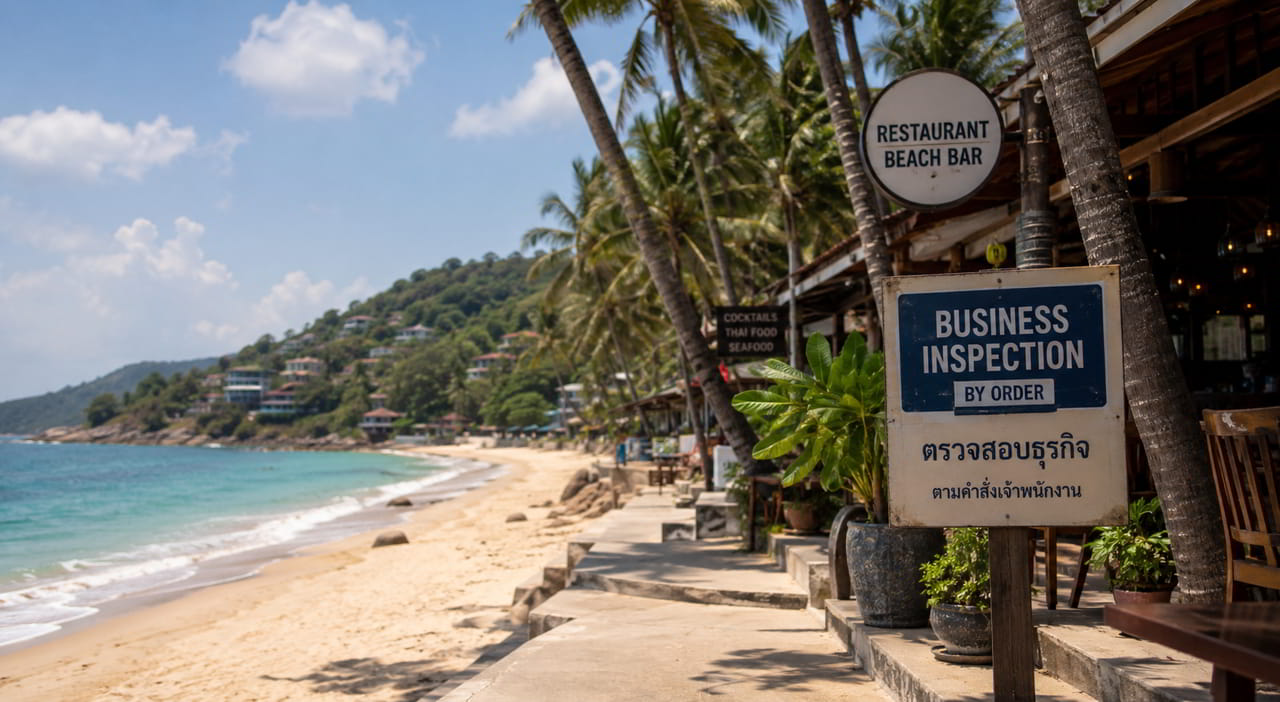









More than 300 police officers raided 32 companies on Koh Pha Ngan on the morning of May 13, in what authorities are calling a major escalation of Thailand’s nationwide campaign against illegal foreign nominee businesses — schemes in which Thai nationals act as legal fronts for foreign investors seeking to sidestep the country’s ownership laws.
Deputy National Police Chief Samran Nualma led the operation, which began at 9 a.m. and drew officers from five agencies, including the Cyber Crime Investigation Bureau, the Immigration Bureau, Provincial Police Region 8, Surat Thani police, and the Crime Suppression Division. The targeted companies collectively hold 37 land plots estimated to be worth around 150 million baht, according to several news sources. Investigators sought to arrest four individuals — one foreign national and three Thai nationals — on suspicion of operating illegal foreign businesses and arranging nominee shareholding schemes.
Officers seized a large volume of corporate and financial evidence from the properties, including company registration records, shareholder documents, land title deeds, lease and sale contracts, bank account statements, and international money transfer records. Digital data and computer equipment were also taken for further examination.
The raids came hours before Prime Minister Anutin Charnvirakul touched down on Koh Pha Ngan for a field inspection. The visit, which also covered Koh Samui, came directly from investigations that have identified more than 11,400 companies across the two islands with suspected links to foreign ownership. Of those, 3,212 are on Koh Pha Ngan and 8,214 on Koh Samui, according to the Department of Business Development. Officials say these figures suggest that close to half of all businesses operating on the islands are connected to foreign investors — many in ways that may violate Thai law.
Koh Pha Ngan has drawn the sharpest scrutiny. According to data from the Department of Business Development, roughly 67% of the island’s registered companies — 3,213 out of 4,761 — involve some degree of foreign investment. Israeli nationals make up the largest group at 22%, followed by French investors at 13% and British investors at 11%.
Among the locations raided Wednesday was a law office that investigators believe served as a coordination hub, helping foreign nationals acquire and control real estate through corporate and legal structures. A luxury villa complex in the island’s Moo 7 subdistrict was also searched. Authorities are examining whether its ownership was legally obtained, according to The Nation.
The Department of Special Investigation has flagged 34 companies across both islands for deeper scrutiny. Each of those firms reportedly holds assets valued at more than 100 million baht. Investigators are also applying what authorities describe as a “financial credibility” test to Thai shareholders in suspect companies — cross-referencing their declared income with the scale of their investments to determine whether they are genuine shareholders or simply lending their names to foreign operators.
The crackdown doesn’t stop at the shores of Surat Thani. Authorities say investigations will expand to Phuket, Krabi, Phang Nga, Pattaya, and Hua Hin — all destinations with high concentrations of foreign-linked businesses. The Department of Business Development and the Department of Special Investigation launched the initiative nationwide, with the two islands serving as the opening front.
Thailand’s Foreign Business Act restricts foreign ownership in a wide range of sectors. Under the law, both the foreign investor and the Thai national acting as their nominee can face up to three years in prison and fines ranging from 100,000 to 1 million baht. Continued violations after a court order can trigger additional daily fines of up to 50,000 baht, according to the UNCTAD Investment Policy Hub.
Government spokesperson Rachada Dhnadirek acknowledged that legitimate foreign investment remains welcome in Thailand. But she made clear the government will pursue those exploiting Thai nationals as legal proxies, describing such schemes as economic crimes that harm fair competition and destabilize the country’s business environment.