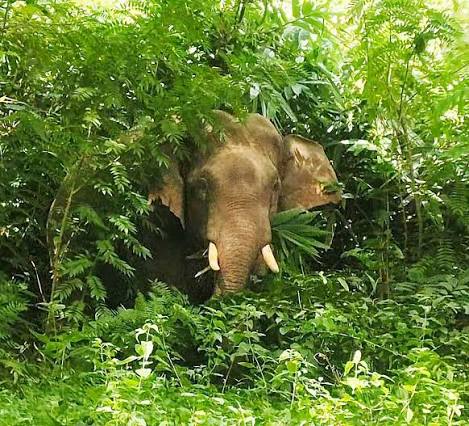









Wildlife welfare groups have asked Thai authorities to open a formal investigation after video circulated online on July 12, 2026, appearing to show a national park officer using a pyrotechnic spark device near a well known wild elephant in Nakhon Nayok province, according to several news sources.
The elephant, known locally as Plai Sarika, is a bull elephant that regularly roams outside Khao Yai National Park and is familiar to residents and visitors in the area. The footage, recorded near Ban Sarika at the entrance to Sarika Waterfall in Sarika subdistrict, Mueang Nakhon Nayok district, showed park personnel trying to push the elephant back toward the forest as it approached homes and orchards.
The clip spread widely on social media, drawing criticism from people who felt the device had been used too close to the animal. In response, two of Thailand’s leading animal protection organizations, the Thai Society for the Prevention of Cruelty to Animals and the Friends of the Asian Elephant Foundation, joined with partner groups to submit a formal letter on July 20 to the chairman of the Animal Cruelty Prevention and Animal Welfare Committee, who also serves as permanent secretary of the Ministry of Agriculture and Cooperatives, several news sources reported. The letter asked authorities to establish the facts of the case and apply relevant animal welfare laws if warranted.
The groups also called for lawmakers to speed up amendments to Thailand’s Animal Cruelty Prevention and Animal Welfare Act of 2014, arguing the law should be expanded to better protect wild animals that regularly come into contact with people, including elephants that roam near tourist areas and farmland.
Khao Yai National Park chief Chaiya Huaihongthong addressed the controversy on July 20, saying the officer seen in the video was part of a rapid response team assigned to monitor Plai Sarika and steer him away from nearby communities. Chaiya said the footage made the distance between the officer and the elephant look shorter than it actually was, and he maintained that staff kept a safe distance throughout the encounter. He also apologized to members of the public who felt uneasy after seeing the images and said the park would review its procedures for handling similar situations.
According to the Department of National Parks, Wildlife and Plant Conservation, Plai Sarika has shown heightened aggression in recent weeks due to musth, a periodic condition in male elephants marked by a sharp rise in testosterone and more volatile behavior. Officials said this made the elephant less predictable and less responsive to the calmer deterrent methods that had worked in the past, prompting staff to rely on louder devices to keep it away from populated areas.
Sathaporn Theerawat, assistant chief of Khao Yai National Park, has been involved in monitoring Plai Sarika for months and has previously reported on the elephant’s health and movements in the area, including earlier incidents in which the animal was treated for injuries. Park officials said a fact finding committee has been set up to review the July 12 incident, with findings expected to be made public once the review is complete.
Human elephant conflict is a recurring issue around Khao Yai, Thailand’s oldest national park and part of a UNESCO World Heritage forest complex that supports one of the country’s largest wild elephant populations. Growing tourism development and encroaching farmland near the park’s boundaries have increased contact between elephants and nearby communities in Nakhon Nayok and neighboring provinces in recent years.
The stakes of that contact are significant on both sides. Wild elephants were linked to more than 227 human deaths across Thailand between 2012 and 2024, according to a Department of National Parks, Wildlife and Plant Conservation report cited by several news sources. Park staff say that history is part of why rangers are trained to use loud deterrents, including flares and firecrackers, to keep elephants such as Plai Sarika away from populated areas rather than relying only on quieter methods.
That same history is why welfare advocates say the manner of any intervention matters, not just the outcome. TSPCA and the Friends of the Asian Elephant Foundation have pressed for stronger oversight of how rangers and volunteers are trained to handle encounters with wild elephants near residential areas, and for clearer rules on what equipment can be used and from what distance.
No injuries to people or to the elephant were reported in connection with the July 12 incident. Park officials said the fact finding committee’s review would be used to update field guidelines for staff working near Plai Sarika and other elephants that frequent the same stretch of the park’s boundary.