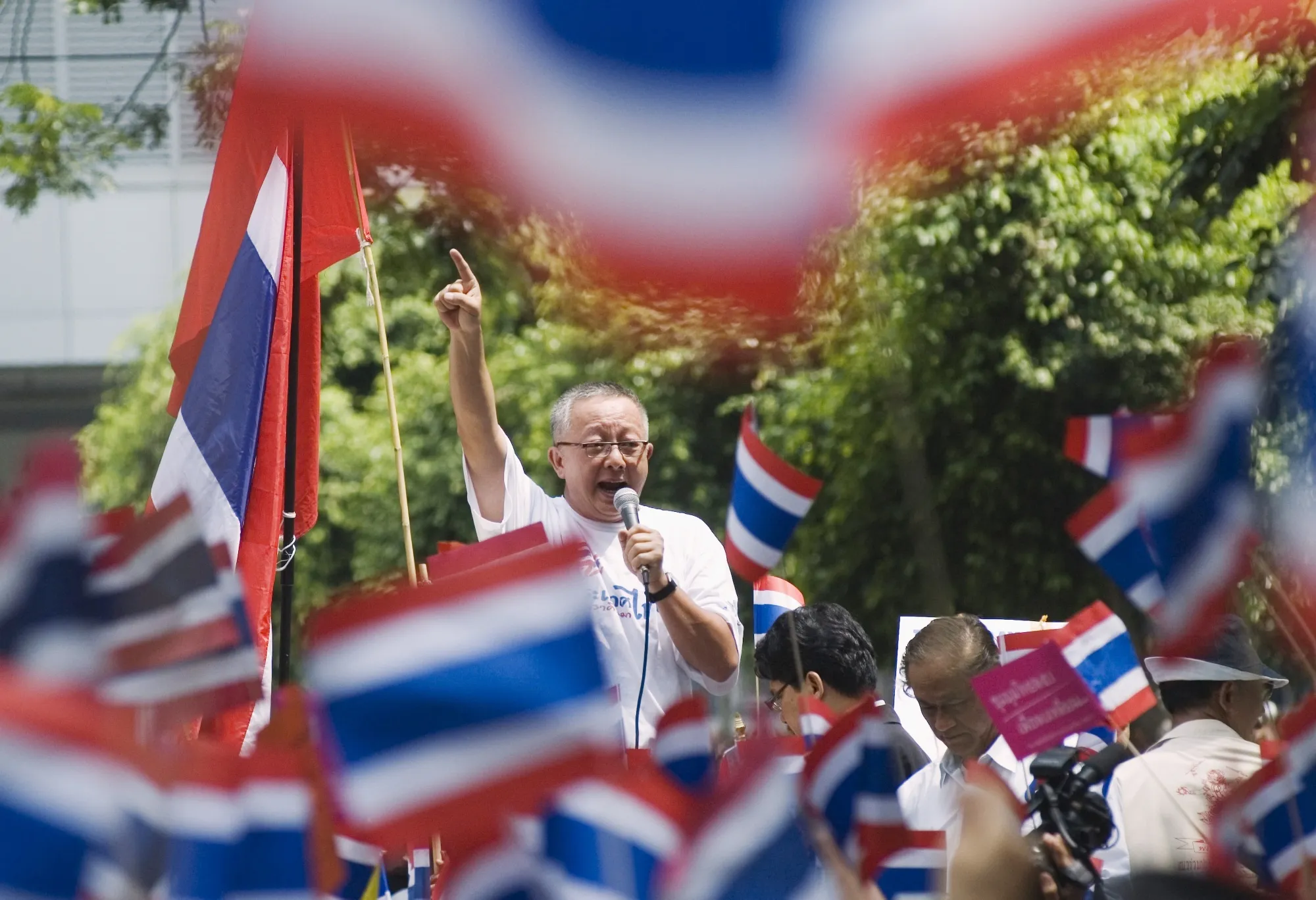









Thailand’s Election Commission faces two separate challenges in Bangkok on Friday, September 25. Veteran protest leader Sondhi Limthongkul and the opposition People’s Party are both pushing back against the agency’s decision to send only 77 people to court in the 2024 Senate election collusion case.
Sondhi and his allies have urged the public to join them in filing a complaint with the Election Commission. The People’s Party plans to take evidence to the National Anti-Corruption Commission (NACC) and ask it to investigate all seven election commissioners for alleged malfeasance in their handling of the case, according to several news sources. Both groups say the commission’s September 14 ruling didn’t go far enough.
The case has been reported as a potential new challenge for Prime Minister Anutin Charnvirakul’s ruling Bhumjaithai Party, which opposition figures have linked to the alleged scheme. The party denies any involvement.
On September 14, the commission voted to ask the Supreme Court to hear cases against 77 people. They include 26 serving senators, 36 Senate voters and 15 other individuals. The case covered 427 accused individuals in total, rather than the 229 figure widely reported in the media.
The commission approved no action under the two categories concerning political assistance to Senate candidates. As a result, no party executives, MPs or political office holders from any party were among those referred. The referral asks the Supreme Court to consider electoral disqualification and is not a final verdict of guilt. Election Commission chairman Narong Klunwarin said the commission had acted within the law and was ready to explain its actions in court.
Before the vote, commissioners had two opposing recommendations in front of them. An investigative panel known as Committee 26 concluded there were grounds for action against all 229 people originally named, while Committee 36 later voted five to two that the case lacked sufficient grounds.
Sondhi, a former Yellow Shirt leader, unveiled a campaign called Take Our Thailand Back earlier this month to monitor the government’s performance. He has said that if the Senate case failed to reach a certain influential figure, people could begin to doubt the justice system and the independence of the agencies involved. Before the ruling, he threatened wider mobilization if the outcome didn’t satisfy him.
The People’s Party is taking a different route. Party leader Natthaphong Ruengpanyawut said earlier this week that the party would submit evidence to the NACC by Friday. He has argued that the alleged collusion involved an organized network, and that the commission was wrong to examine individuals in isolation.
Natthaphong has also noted that four of the seven current commissioners entered office through selection and endorsement by the present Senate. He says that link leaves the majority decision open to perceptions of political favors. The party has also announced plans for legal action against the Election Commission and a no-confidence motion.
The Senate’s role is what raises the stakes. The chamber scrutinizes bills passed by the lower house and appoints the heads of key bodies such as the Constitutional Court, the NACC and the Election Commission. The contested selection took place in June 2024. It was the first since the 2014 coup, after which senators had been chosen by the military.
Bhumjaithai has rejected the allegations. On September 15, Deputy Prime Minister Phiphat Ratchakitprakarn said the party had no involvement in the case and that Anutin had repeatedly said the same. He added that the party couldn’t interfere in Senate affairs because senators don’t belong to political parties.
The dispute has also reached the Department of Special Investigation (DSI). The DSI has been separately investigating allegations of criminal association, conspiracy and money laundering linked to the Senate selection. Earlier this week, the Cabinet approved Piya Raksakul as the DSI’s new director-general, replacing Yutthana Praedam.
Piya sat on Subcommittee 36 and was among the five members who voted to recommend dismissing the allegations. The People’s Party has warned that the agency could be turned into a political tool or used to benefit people facing criminal charges. Justice Minister Rutthaphon Naowarat said the appointment was based on Piya’s suitability and past performance, and rejected suggestions that it was politically motivated or linked to the Senate case.
The main case now moves to the Supreme Court, which will consider the petitions against the 77. None of those referred to has been publicly identified.