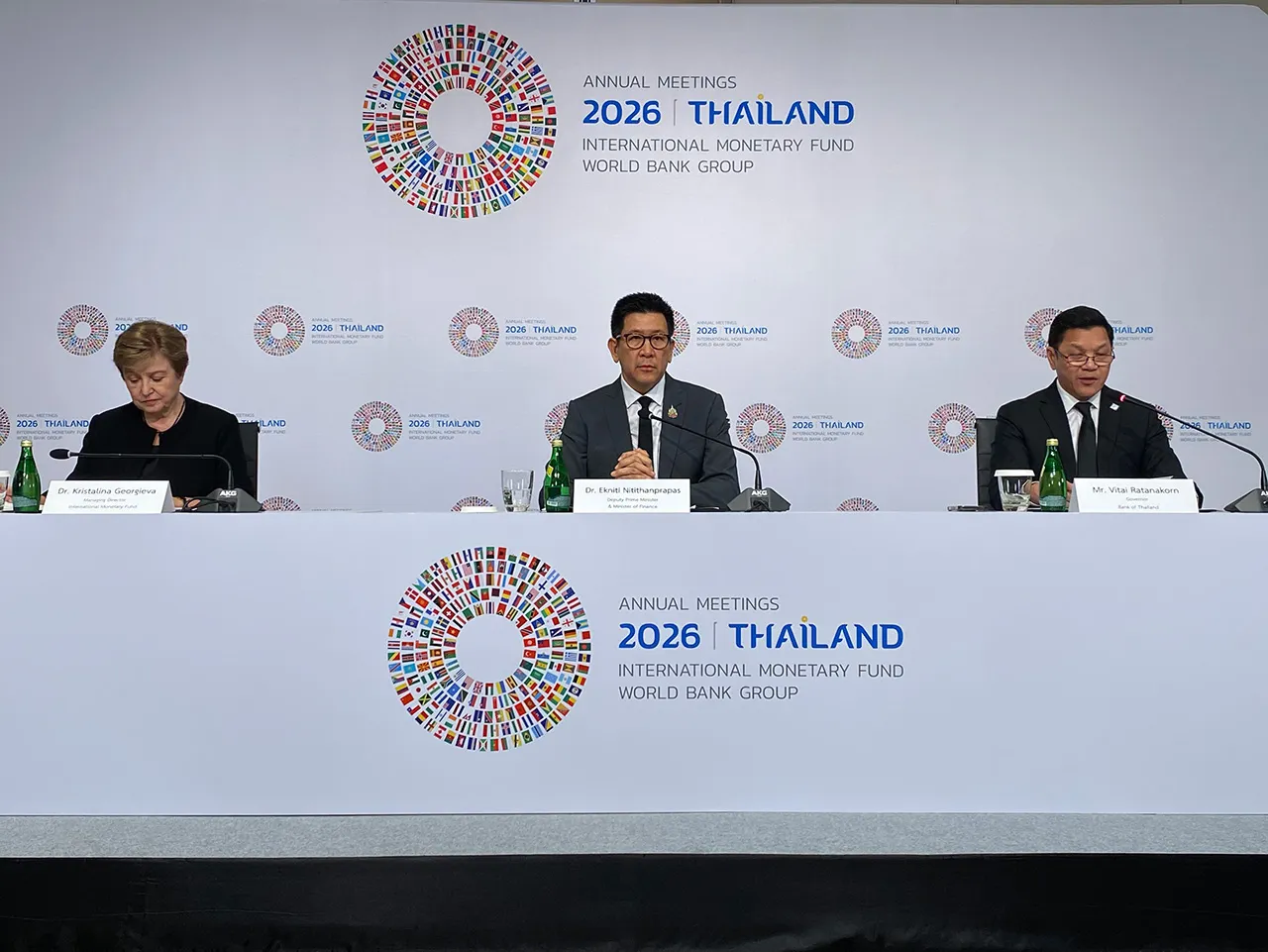









Thailand is among the Asian economies where the number of people of working age is already falling, the International Monetary Fund said Monday as it launched a new study on the region’s future at the IMF and World Bank Annual Meetings in Bangkok. The fund said the economic drag from aging could be fully offset if productivity grows fast enough. It pointed to artificial intelligence, more women in the workforce and deeper regional trade as the main ways to get there.
The book, Shaping the Future of Asia: Opportunities and Challenges, was presented at the Queen Sirikit National Convention Center by Krishna Srinivasan, director of the IMF’s Asia and Pacific Department, after opening remarks from Managing Director Kristalina Georgieva. It groups Thailand with Japan, South Korea and China as post-dividend economies, meaning their labor forces have stopped growing and started to shrink.
In those economies, the working population could fall by as much as a quarter by 2050, according to several news sources covering the launch. Across Asia, the share of people aged 65 and older is expected to rise from 11 percent to 20 percent by mid-century. Fertility in the region has dropped from about six children per woman to about 1.6, well below the level of 2.1 needed to keep a population stable.
For Thailand, the findings sharpen a problem that has been building for years. The IMF warned as far back as 2017 that parts of Asia risked growing old before growing rich, and it named Thailand at the time among the economies aging fastest. A shrinking labor pool leaves fewer workers to support a growing number of retirees.
The study’s central message is that productivity can close the gap. Srinivasan told the audience that productivity growth of 0.8 percent a year would be enough to cancel out the demographic drag entirely, even in post-dividend economies.
AI could do much of that work. The IMF estimates that wide adoption could add 0.5 to 1 percentage point to annual growth in Asia’s advanced economies, and 0.2 to 0.8 point in emerging and developing ones, a group that includes Thailand. Srinivasan stressed that these figures are scenarios, not forecasts. Georgieva told the launch that if countries capture the productivity gains from AI, they would more than make up for the pressure from aging.
The book also looks at people the labor market leaves out. Raising women’s employment to the level of men’s would add about 112 million workers across the region, according to the IMF. The fund also urged governments to help older people stay in work longer.
Trade is the third lever. Global trade restrictions have nearly tripled since 2019, a serious risk for a region that depends heavily on exports. Within Asia, trade in finished goods makes up only about 30 percent of the total, compared with about 60 percent in Europe. Deeper trade agreements that cut tariffs and other barriers could lift regional output by about 1.8 percent over the long term, and by up to 4 percentage points for ASEAN economies, according to figures presented at the launch.
Veerathai Santiprabhob, a former Bank of Thailand governor who now chairs the Thailand Development Research Institute, was the Thai voice on the panel. He credited Thailand’s rise to its turn toward private sector exports in the 1980s, investment in the Eastern Seaboard industrial hub, and steady technocratic management that held up through political swings. Universal health care and wider access to education helped spread the gains, he said.
Looking ahead, Veerathai warned that the higher value industries Thailand is now chasing don’t create jobs in large numbers. He called for policy to focus on agriculture, education and public services, which shape the cost of living for most people, and for support to keep small businesses competitive. He also said workers between 45 and 60 could be displaced as companies adopt AI, and he urged governments to make creating good jobs a primary goal.
For Thailand, the study points to a narrow path. Its workforce is already shrinking, and the IMF’s main remedy, faster productivity growth driven in part by AI, rests on estimates the fund itself describes as scenarios rather than forecasts. Panelists at the launch also disagreed on how quickly AI’s benefits will arrive. That leaves the outcome hinging on policy choices in Bangkok, from helping more women and older people stay in work to opening up trade within the region. Those questions will stay in focus as the Annual Meetings continue at the Queen Sirikit National Convention Center through October 18.