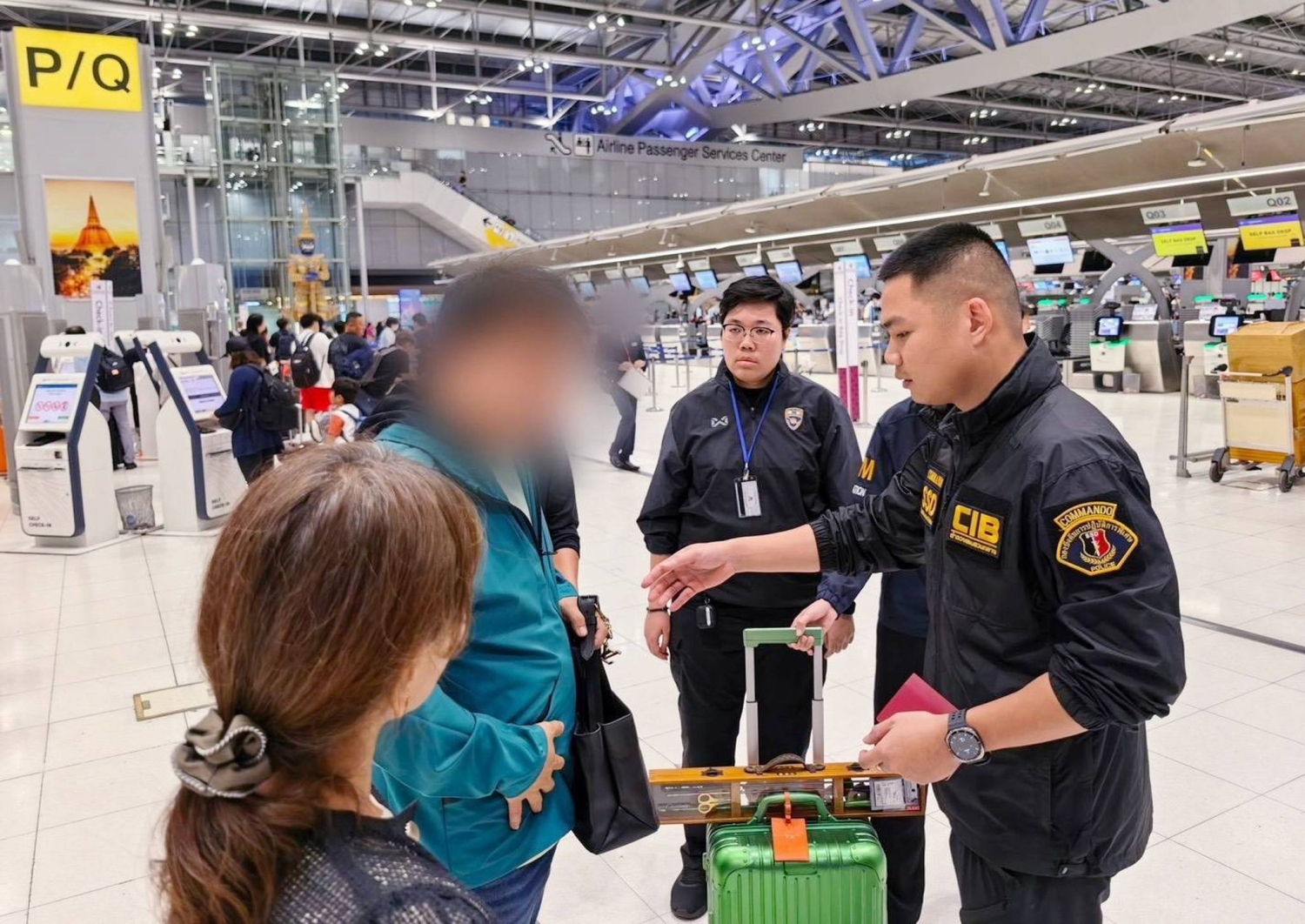









Thailand’s crackdown on transnational fraud networks produced two high-profile arrests within three days, as Thai authorities captured a pair of Japanese nationals suspected of running separate call-centre scam operations out of Cambodia — one caught hiding in Bangkok, the other stopped at the airport as he tried to board a flight out of the country.
On Sunday evening, officers from the Central Investigation Bureau and the Immigration Bureau detained a 31-year-old Japanese man identified as Takafumi Sugawara at Suvarnabhumi Airport, after his permission to remain in Thailand had already been revoked. He was apprehended at a Malaysia Airlines check-in counter at 6:30 p.m. before he could board a flight to Malaysia.
Japanese investigators linked Sugawara to a yakuza organisation and accused him of acting as a key commander of a call-centre fraud network operating out of Cambodia. The gang was connected to at least 40 victims in 2024 and defrauded them of roughly 1 billion yen — around 200 million baht.
The network operated in three stages. Victims in Japan first received automated calls claiming to be from telecommunications company NTT, warning them their phone line was about to be cut off. Those who responded were transferred to a team that extracted their personal information. They were then passed to a third group posing as police officers and prosecutors, who told victims their bank accounts were linked to criminal activity and pressured them into transferring money for supposed verification. They never got it back.
Beyond defrauding victims directly, Sugawara is also suspected of recruiting Japanese nationals through fake job advertisements and sending them to Cambodia, where they were forced to work inside the scam operation. He was taken to an Immigration Bureau detention facility and is pending deportation to Japan to face legal proceedings.
The arrest came just three days after a separate but related bust in Bangkok’s upscale Thonglor district. A 38-year-old Japanese national identified by Thai authorities as Sasaki was arrested in connection with a different call-centre fraud network also based in Poipet, Cambodia, accused of causing losses of several billion yen. Sasaki had been wanted under a warrant issued by the Nagoya District Court on April 1, 2026, and Japanese authorities had identified him as a key figure directing cross-border fraud operations linked to human trafficking.
According to Thai investigators, Sasaki managed the Poipet operation remotely while living in Bangkok, working alongside Chinese managers at the Cambodian compound to recruit heavily indebted Japanese nationals and traffic them to the site. There is no record of him having traveled to Cambodia himself — he was living in a luxury apartment in Bangkok at the time of his arrest. He is also expected to be extradited to Japan.
Thai authorities said the back-to-back arrests reflected successful intelligence sharing between Thailand and Japan, and confirmed they would continue targeting the senior leadership of such networks rather than lower-level operators.
Both operations fall under Prime Minister Anutin Charnvirakul’s broader push to dismantle call-centre gangs and eliminate human trafficking from Thailand. The country has faced sustained pressure to stop being used as a base or transit point by criminal networks operating primarily out of Cambodia, which a 2026 UN report estimated runs a scam industry worth more than $43.8 billion a year in the Mekong region alone.
Thai authorities used the occasion to warn the public to be cautious of overseas job advertisements promising high income, easy work, and free travel, saying such offers are frequently connected to transnational human trafficking and scam operations.