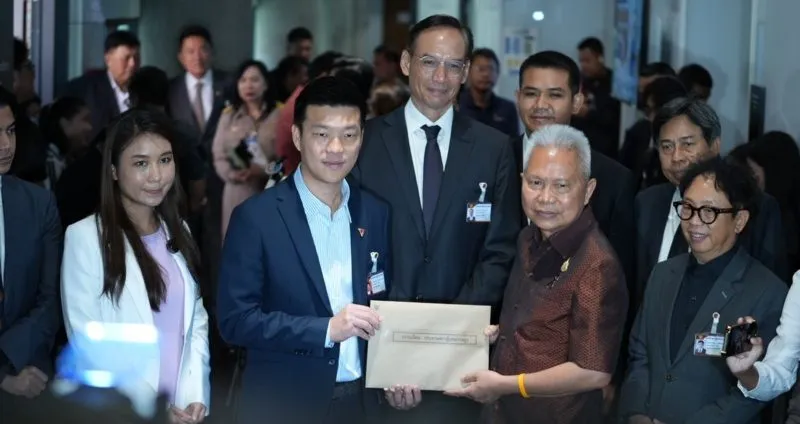









Thailand’s opposition bloc escalated its fight against the government’s emergency borrowing plan on Monday, formally petitioning House Speaker Sophon Saram to refer the 400-billion-baht ($12 billion) borrowing decree to the Constitutional Court — setting up a political and legal collision just days before parliament is scheduled to vote on the package.
People’s Party leader Natthaphong Ruengpanyawut, the party’s deputy leader Sirikanya Tansakun, and Democrat Party deputy leader Korn Chatikavanij jointly delivered the petition to Sophon at parliament on May 11, asking him to trigger a Constitutional Court review under Section 173 of the charter. Sophon said he would verify the motion’s accuracy before forwarding it, and pledged to move quickly given that the decree is due before the House of Representatives on May 14.
The cabinet approved the emergency decree on May 5 and it took effect when published in the Royal Gazette on May 9. The package splits into two equal parts: 200 billion baht in direct relief for households, low-income earners, farmers, fisherfolk, and small businesses hammered by rising energy and food costs; and 200 billion baht for Thailand’s long-term transition away from fossil fuels, covering renewable energy projects, electric vehicle infrastructure, carbon credit systems, and skills development tied to the country’s economic restructuring.
Prime Minister Anutin Charnvirakul framed the borrowing as unavoidable, arguing that the ongoing Middle East conflict has driven up global oil prices and spread the damage through food costs and household expenses across Thailand. His government has warned of stagflation — a sustained period of high inflation alongside weak growth — pointing out that Thailand is one of Asia’s most energy import-dependent economies. The Bank of Thailand has revised its 2026 GDP growth forecast down to 1.5 percent, with inflation projected to reach 2.5 to 3.5 percent for the year, according to several news sources.
The fiscal picture tightens the stakes considerably. Thailand’s public debt stood at roughly 66 percent of GDP as of February 2026, according to Finance Ministry figures. Adding the full 400 billion baht would push that ratio to approximately 68.2 percent — leaving the government with less than two percentage points of headroom below the legally mandated 70 percent ceiling. The Finance Ministry has projected the ratio could climb as high as 69.9 percent by the end of fiscal year 2027 if the Middle East conflict persists and energy costs remain elevated.
The opposition’s challenge is surgical rather than wholesale. Both the People’s Party and the Democrat Party have made clear they do not oppose the 200-billion-baht relief portion of the decree. Their target is the other half — the energy restructuring allocation — which they argue lacks the urgency required under Section 172 of the constitution for an emergency decree to be lawfully issued. Korn argued that unlike previous emergency borrowing events during the 1997 financial crisis, the 2009 global downturn, and the COVID-19 pandemic, Thailand’s economy has not contracted — it grew 2.6 percent last year and is still projected to expand, if modestly, in 2026. The opposition has also proposed alternatives, including reallocating up to 50 billion baht in unspent budget funds, using remaining fiscal-year borrowing room, passing a mid-year budget bill, and cutting excise taxes on fuel by seven baht per liter.
Anutin dismissed those alternatives as too slow and too small in scale. Finance Minister Ekniti Nitithanprapas said that even combining all available reallocation options would fall far short of what’s needed, and that the 2027 budget won’t take effect until October 1 — leaving a five-month gap during which the government says it has no adequate funding mechanism without the decree. Anutin has also vowed to take personal responsibility if the program fails to deliver, and has noted that the Democrats themselves issued a borrowing decree of the same size in 2009 under the Thai Khem Khaeng stimulus scheme — a point his government has repeated frequently in defending its position.
If the House Speaker forwards the petition before the May 14 parliamentary session, the Constitutional Court could issue an interim suspension order for the energy restructuring portion, potentially freezing half the package while a ruling is prepared. A court review typically takes weeks, but the opposition has asked specifically that only the 200-billion-baht energy tranche be suspended — not the relief payments. The first disbursements under the decree are scheduled to begin in June, targeting welfare card holders and low-income earners, according to several news sources.
The government has said domestic borrowing will be used to fund the full package, with repayments of principal and interest built into the annual budget at roughly 150 billion baht per year. Officials insist Thailand’s public debt trajectory remains manageable and well below the levels of many peer economies. What happens in the next 72 hours — whether the Speaker acts before Thursday’s House session, and whether the court accepts the petition — will determine whether the money starts flowing on schedule or gets tied up in a legal standoff that neither side wants to own.