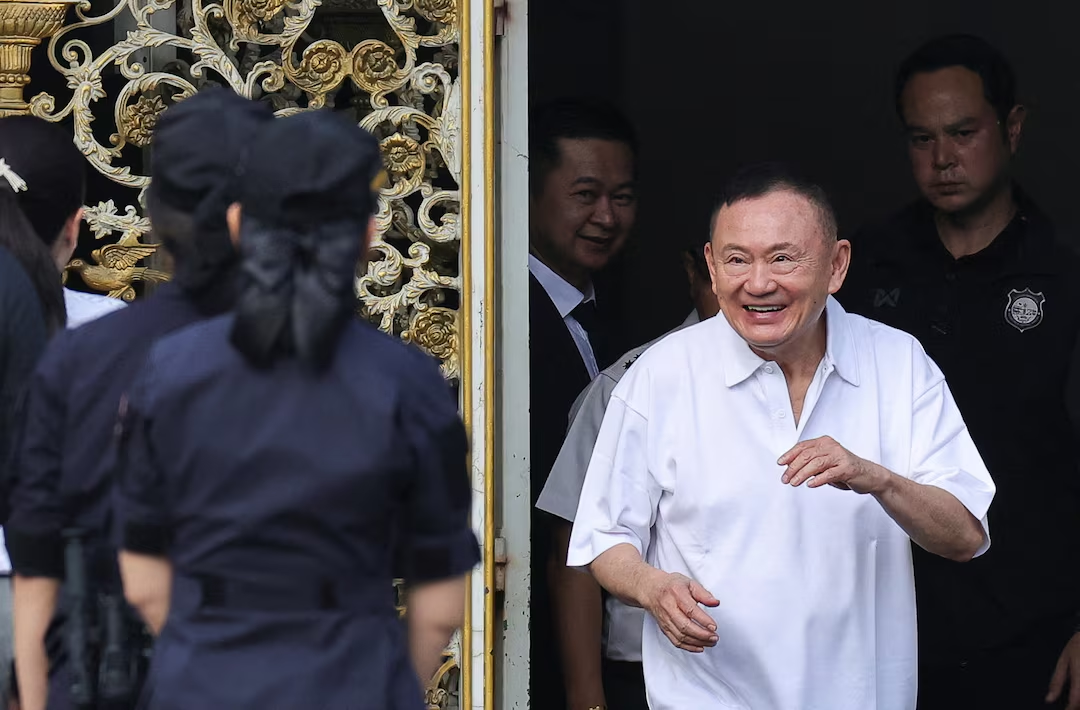









Former Prime Minister Thaksin Shinawatra walked out of Klong Prem Central Prison in Bangkok on Monday morning, ending eight months of incarceration and reopening questions about his role in Thai politics that have defined and divided the country for more than two decades.
Wearing a white polo shirt and blue pants, Thaksin emerged from the prison gate at around 7:40 a.m. and was immediately embraced by family members, including his daughters Paetongtarn and Pintongta Shinawatra. He smiled as he walked through the crowd, greeting supporters who handed him red roses and chanted “we love Thaksin,” then left without speaking to reporters. He arrived at his residence in western Bangkok roughly an hour later, where he rolled down his car window to address waiting supporters and journalists. According to several news sources, Thaksin told reporters he had “gone into hibernation for eight months” and said he felt “relief” following his release.
About 300 supporters and political allies had gathered outside Klong Prem to greet him, many having arrived the previous evening with some staying overnight near the prison. Police had issued traffic advisories for surrounding roads from Sunday afternoon through midday Monday in anticipation of the crowds.
According to the Corrections Department, Thaksin will be required to wear an electronic ankle monitor for the remainder of his sentence. He will remain on probation until September 9, 2026 — four months from his release — during which time he must report regularly to probation officers, reside at his declared address in Bangkok, and comply with all conditions. He is prohibited from traveling abroad.
The circumstances that put Thaksin in Klong Prem were themselves the result of a protracted legal battle. He returned to Thailand in 2023 after more than 15 years in self-imposed exile to face an original eight-year sentence for conflicts of interest and abuse of power during his time as prime minister, a sentence King Maha Vajiralongkorn later commuted to one year. Rather than serving that sentence in prison, he was transferred to a suite at Bangkok’s Police General Hospital on medical grounds, where he remained for six months. The Supreme Court ruled in September 2025 that he and his doctors had prolonged his hospital stay with minor and unnecessary procedures, ordering him to serve the balance of his sentence in actual custody. The Justice Ministry’s parole committee granted his early release last month, citing his age, good behavior, and low risk of reoffending.
The 76-year-old billionaire reshaped and dominated Thai politics for a quarter-century. He was elected prime minister in 2001 and again in 2005, and took himself into exile after his second term was cut short by a military coup in 2006. His removal from power triggered deep and sometimes violent political polarization that has never fully healed — with his supporters, largely rural and working-class, pitted against a conservative royalist establishment that viewed his populist politics as a challenge to the traditional order.
The party he built, Pheu Thai, and its earlier iterations became Thailand’s most electorally dominant force of the 21st century — until this year. The party had its worst election result on record in February 2026, slipping to third place and raising serious questions about the future of the Shinawatra political dynasty. Pheu Thai has since joined the governing coalition of conservative Prime Minister Anutin Charnvirakul, with Thaksin’s nephew Yodchanan Wongsawat serving as minister of higher education in Anutin’s cabinet.
Thaksin’s daughter Paetongtarn became the country’s youngest prime minister in 2024 but was removed from office by the Constitutional Court in August 2025 after a recording emerged of a compromising phone call with former Cambodian leader Hun Sen. She was the sixth leader from the Shinawatra family, or backed by it, to be removed by courts or coups.
Analysts note that Thaksin still has pending criminal cases against him, which may discourage him from making high-profile political moves that could risk further prosecution. The more likely path, according to several news sources, is a return to behind-the-scenes influence within Pheu Thai as the party looks to rebuild ahead of the next election cycle. Whether that amounts to a genuine political comeback — or the final chapter of a dynasty in decline — will become clearer in the months ahead.