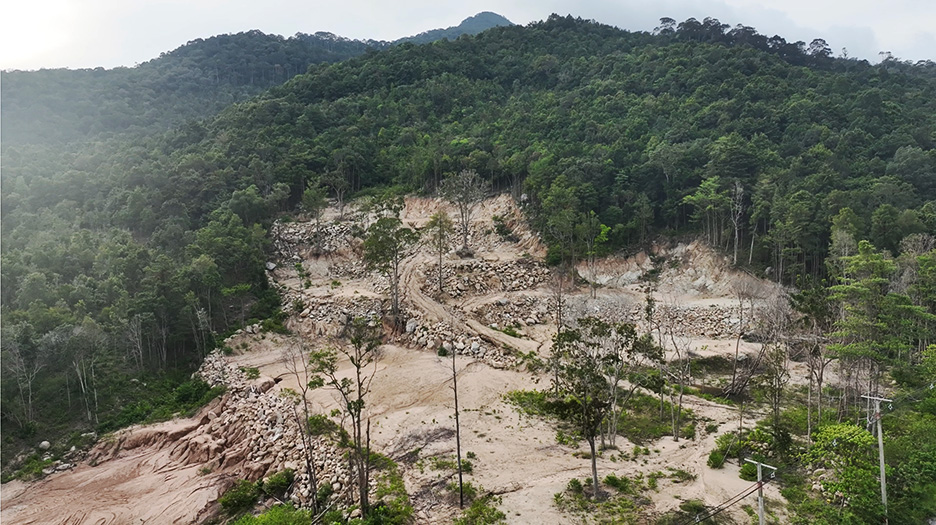









Thai police descended on the island of Koh Phangan before dawn on Saturday in one of the largest law enforcement operations in the resort destination’s history, arresting up to 22 foreign nationals and seizing more than 200 million baht worth of land in a sweeping crackdown on illegal nominee business networks that authorities say have quietly taken root across the island for years.
The second phase of the operation launched at 6 a.m. on May 23, with more than 300 officers executing 36 court-approved search warrants across the island under the command of Pol. Lt. Gen. Noppasin Poolsawat. Investigators simultaneously pursued 39 criminal cases and secured 45 arrest warrants targeting foreign nationals accused of illegally operating businesses restricted to Thai citizens and acquiring land through Thai proxy shareholders, according to several news sources.
At the heart of the operation was a scheme that, on paper at least, looked perfectly legal. Foreign investors would register companies with Thai shareholders listed as majority owners — often low-income individuals with welfare cards or ordinary employees — while the real control and financial benefit remained firmly with the foreign national behind the operation. The Department of Special Investigation has been applying a financial credibility test to expose these arrangements, cross-referencing the declared incomes of Thai shareholders with multi-million-baht investment stakes that simply don’t add up.
One of the most striking cases uncovered during the raids involved a company called FB Properties Co. Ltd., operating on Koh Phangan under the name “The Yoga House.” Investigators say the true beneficial owner was an Israeli national who allegedly used Thai nominees to conceal full ownership of the business. Police found that the company held eight plots of land covering roughly 7.5 rai, valued at more than 60 million baht — not counting the buildings on those properties. The business was also allegedly operating a hotel without the required government permits.
Authorities divided the operation’s findings into two groups. The first consisted of 32 companies identified as clear nominee operations. From this group, 22 foreign nationals were arrested and 45 land plots covering more than 40 rai were seized, with estimated damages exceeding 200 million baht. Charges included operating foreign businesses without permission and illegal land ownership. The second group involved another 32 companies where foreign shareholders appeared to hold greater control than their Thai counterparts. Those firms collectively controlled 38 additional land plots, most of them undeveloped. Police conducted inspections at 21 of those companies to build evidence for further legal proceedings.
The suspects come from a range of countries. Those confirmed in custody include Israeli, French, Russian, and Ukrainian nationals, alongside individuals from Slovakia, the Netherlands, Australia, Turkey, Germany, the Philippines, and several African nations, according to several news sources.
On Monday morning, 21 of those arrested — one suspect could not be detained under an outstanding warrant — were brought before the Samui Provincial Court as police formally opposed bail. Investigators are seeking an initial detention period of 12 days, with the law permitting extensions of up to 48 days before prosecutors receive the case. Authorities have been using an analytical system called SPNI X — developed in Thailand to track drug and money-laundering networks — to trace financial transactions and map ownership structures across the suspect companies.
This wasn’t a sudden response to a new problem. Enforcement actions on Koh Phangan have been building since at least 2024, and a first phase of this particular operation launched on May 13 with raids on five law firms and accounting offices suspected of helping foreign investors structure illegal arrangements. More than 100 foreign-linked companies were allegedly registered at a single address, according to several news sources. The island’s hotel and tourism association publicly welcomed the crackdown, urging authorities to press further and also improve the destination’s overall image.
Thailand’s Foreign Business Act has long restricted foreigners from owning land or operating certain businesses in the country. Critics argue that enforcement has historically been uneven, allowing a shadow economy of nominee arrangements to flourish in popular tourist destinations from Phuket to Koh Samui. Saturday’s operation, backed by a national directive from the government, signals that the Anutin administration intends to make an example of Koh Phangan — and that other islands may not be far behind.