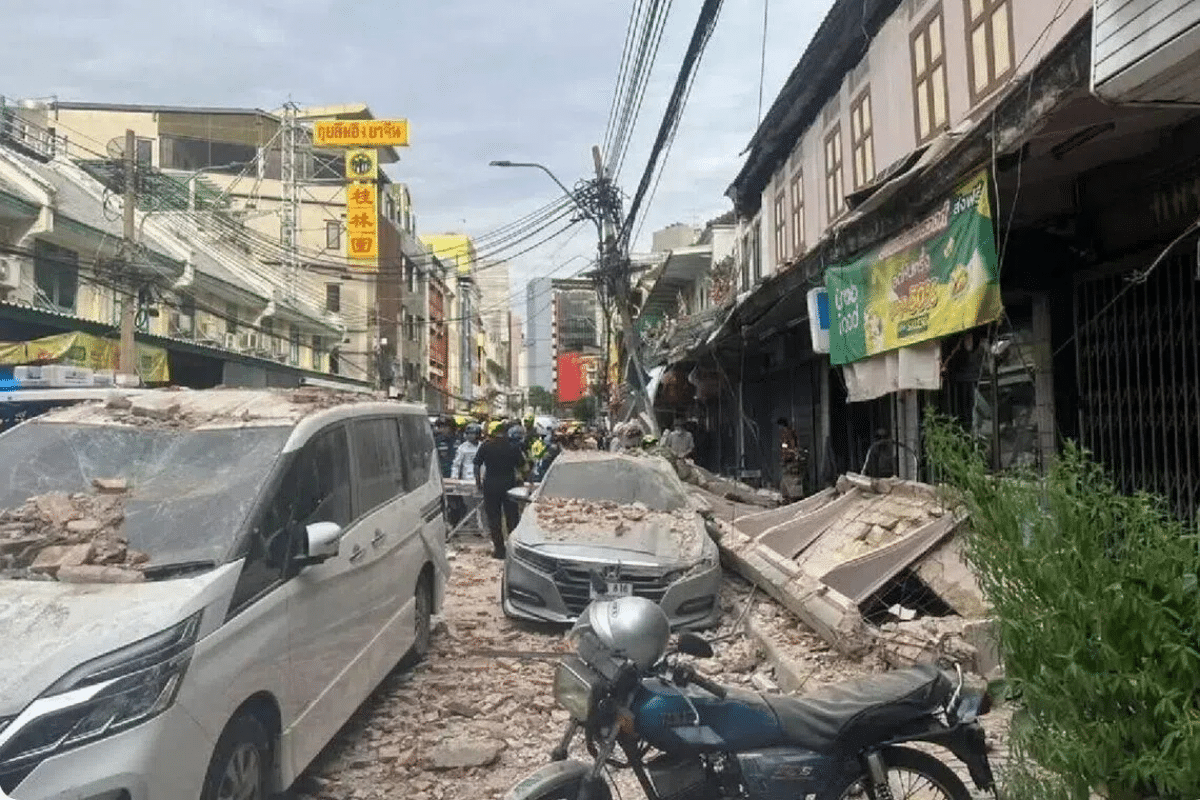
A crumbling shophouse in central Bangkok and a waterproofing job gone wrong inside a railway tunnel in northern Thailand killed three people on the same Saturday afternoon, June 20, a coincidence that has put Thailand’s construction and building safety record under renewed and uncomfortable scrutiny.
The first incident happened at 4:52 p.m. on Charoen Krung Road in the Talat Noi area of Bangkok’s Samphanthawong district, near Wat Traimit Witthayaram Worawihan. A concrete balcony canopy tore away from a century-old two-storey shophouse and crashed onto the street below. A 67-year-old man walking beneath it was struck and killed. A second person was injured. At least three vehicles were also damaged. CCTV captured the collapse at the moment it happened, and the footage spread quickly online; witnesses said they initially mistook the sound for a falling electricity pole before a cloud of white dust and debris engulfed the street. Firefighters and rescue workers from the Suan Mali station arrived to recover the victim’s body, and the Metropolitan Electricity Authority cut power to the area while crews cleared debris through the evening. By Sunday, Rama IV Road remained partially closed as the Samphanthawong district office sealed off all five shophouse units in the row.
The building stood on land owned by Wat Traimit and was estimated to be close to a hundred years old, according to several news sources. The structure was built without piling, a common practice for buildings of that era, and residents had reported small fragments of brick and plaster falling from the structure over time in the period before the collapse.
Prof. Amorn Pimanmas, president of the Thailand Structural Engineers Association and a structural engineering faculty member at Kasetsart University, said the balcony canopy showed limited anchor points and used plain round steel bars rather than the deformed bars required under modern construction standards. The combination of material deterioration, rusting reinforcement, an inherently vulnerable cantilever design, and potentially inadequate original anchoring were all factors under investigation. He said Bangkok’s inner city had many buildings between 50 and 100 years old, and that engineering principles hold the service life of concrete structures at roughly 50 to 60 years before materials begin to degrade. Projecting elements like balconies and canopies were among the most vulnerable parts of such structures because they carry heavy loads in an outward direction with support fixed on only one side. He called on the Bangkok Metropolitan Administration to move urgently under the Building Control Act and a 2020 ministerial regulation that allows local officials to act on buildings they assess as posing a danger to public life and property.
Meanwhile, in Doi Luang district of Chiang Rai province, workers on the State Railway of Thailand’s flagship northern infrastructure project were about 90 minutes earlier in their own emergency. At around 4:30 p.m., inside the 3.4-kilometer Doi Luang railway tunnel; part of the Den Chai–Chiang Rai–Chiang Khong double-track line, rocks fell from the tunnel wall onto workers installing a waterproofing membrane system. Two workers were killed: Apidech, 24, from Kanchanaburi province, and a 29-year-old Myanmar national identified only by one name. Two others were seriously injured and four sustained minor injuries. All injured were transported to Doi Luang Hospital and Chiang Rai Prachanukroh Hospital. The contractor on the section is the CKST-DC3 consortium, which includes Ch. Karnchang, Sino-Thai Engineering and Construction, and Chiang Mai Construction.
The State Railway of Thailand issued a statement the following morning expressing condolences and announcing a temporary two-day halt to work at the site, with engineers and safety officials ordered in to assess the tunnel’s structural condition before work resumes. The agency also ordered a safety review across all ongoing tunnel and large-scale infrastructure projects. Deputy Transport Minister Siripong Angkasakulkiat confirmed the accident and said the investigation remained at a preliminary stage.
The two incidents arriving on the same day add pressure to what is already a sensitive public conversation in Thailand about structural safety. That conversation has been running since March 2025, when the State Audit Office building in Bangkok collapsed during a Myanmar earthquake, killing 95 people in the single deadliest structural failure in Thailand’s modern history. Investigations since then have pointed to substandard steel and construction deficiencies, and criminal charges have been filed against multiple individuals. The Doi Luang tunnel accident is not the first of its kind either; three workers were also killed last year when a separate train tunnel under construction collapsed in Pak Chong district of Nakhon Ratchasima.
Thailand’s construction sector is in the middle of a significant expansion: the Den Chai–Chiang Rai–Chiang Khong line alone carries an 85.3-billion-baht budget and covers 323 kilometers. The pressure to meet timelines and the sheer scale of simultaneous infrastructure work make safety enforcement difficult. Engineers, investigators and officials now have another two sites to explain and a broader public, primed by the last year’s events, is watching closely.