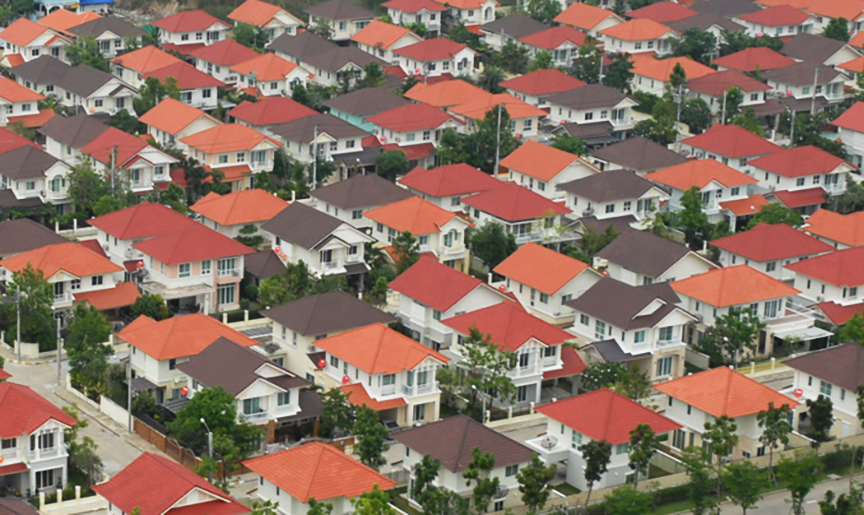
Bangkok’s second-hand housing market entered 2026 in a state that no seller wants to see: a massive surge in listings, a 234% spike in total listed value, and buyers who either can’t or won’t pull the trigger. New data from the Real Estate Information Center (REIC) show that 70,495 pre-owned homes were listed for sale in Bangkok in the first quarter of 2026, with a combined asking price of 701.25 billion baht; a number that would have seemed impossible just a year earlier.
The volume alone represents a jump of roughly 118% compared to the same period a year ago, according to several news sources citing REIC data. These aren’t just small condominiums flooding the market. Detached houses, luxury units, and mid-range townhouses all contributed to the surge, pushing the total listed value to levels that reflect how much wealth is now sitting on the market, waiting for buyers who haven’t arrived in large enough numbers.
Bangkok has consistently dominated Thailand’s second-hand housing landscape, and Q1 2026 was no different. The capital accounts for roughly 60% of the national second-hand market by total asking-price value, according to REIC’s spatial analysis of second-hand housing supply across provinces. No other city comes close.
What makes the listing surge difficult to ignore is that it’s happening while demand is moving in the opposite direction. Nationwide, actual ownership transfers of second-hand homes rose 13.8% in volume in the first quarter; encouraging on its face, but still far outpaced by how fast new listings are arriving. New home transfers, by comparison, fell 1.1% in value over the same period, according to the Bangkok Post, underscoring a broader shift in buyer preference toward the resale market — but not at a pace fast enough to clear the backlog building across the city.
The most direct explanation for the listing explosion is financial pressure on households. Thailand’s household debt stood at 86.7% of GDP at the end of 2025, based on data released by the Bank of Thailand — one of the highest ratios in Asia. A national survey conducted by the Trade Policy and Strategy Office in February 2026 found that 62.44% of Thais were carrying debt, up sharply from 50.99% the year before. Rising living costs, a fragile labor market, and tighter credit conditions at commercial banks have all contributed to a situation where many homeowners are choosing, or being forced to, sell assets to raise cash.
Mortgage access has tightened considerably. Lenders, particularly commercial banks, have pulled back on new loans as default risks rise, while state-backed financial institutions are absorbing more of the demand from lower-income borrowers. The practical effect for sellers is a smaller pool of qualified buyers, even as the number of sellers grows.
The government has tried to prop up the broader property market with incentives. A reduction in transfer and mortgage registration fees; part of a package of stimulus measures known as the “Quick Big Win” program, has been in place since April 2025 and runs through the end of June 2026. The policy helped push a modest recovery in transfers in late 2025, but it has not been enough to significantly reduce the stockpile of unsold listings in Bangkok.
What the numbers ultimately describe is a market caught between two forces pulling in opposite directions. On one side, there’s a growing urgency among homeowners to convert property into cash. On the other, buyers are constrained; by tight credit, by economic uncertainty, and by the simple mathematics of trying to secure a mortgage when household budgets are already stretched thin.
For prospective buyers with the financial standing to access loans, the current environment offers something unusual for Bangkok: a wide selection of resale homes across price points, in a city where property historically moves in the seller’s favor. Whether that window stays open depends largely on what happens after June 30, when the government’s reduced-fee incentive is set to expire.