Thailand’s aviation sector secured a significant boost this week after four international carriers were granted flight slots to operate new routes into the country for the upcoming winter tourism season, as authorities look to inject fresh air connectivity into a tourism industry that has posted back-to-back years of declining arrivals.
The Civil Aviation Authority of Thailand announced the slot allocations following the 158th International Air Transport Association Slot Conference, held in Bangkok from June 9 to 11. Of 146 airlines that attended the conference, 87 requested meetings with Thai aviation officials; a level of interest that CAAT described as a reflection of confidence in Thailand’s potential as a regional aviation hub.
The four carriers awarded new slots are Riyadh Air of Saudi Arabia, Virgin Atlantic of the United Kingdom, AirBorneo of Malaysia, and SkyUp Nistru of Moldova. Their services are set to begin when the winter schedule opens on October 25, running through March 27, 2027, covering Thailand’s peak tourism months.
Riyadh Air, one of Saudi Arabia’s newest commercial carriers, will operate seven flights a week between Riyadh and Bangkok’s Suvarnabhumi Airport. The route represents a direct link between Thailand’s main international gateway and the Saudi capital, coming at a time when the two countries have worked to rebuild a tourism relationship that was severed for more than three decades before diplomatic ties were restored. According to several news sources, Thailand’s Tourism Authority has been actively cultivating the Saudi market and was planning to open a dedicated office in Riyadh to support that push.
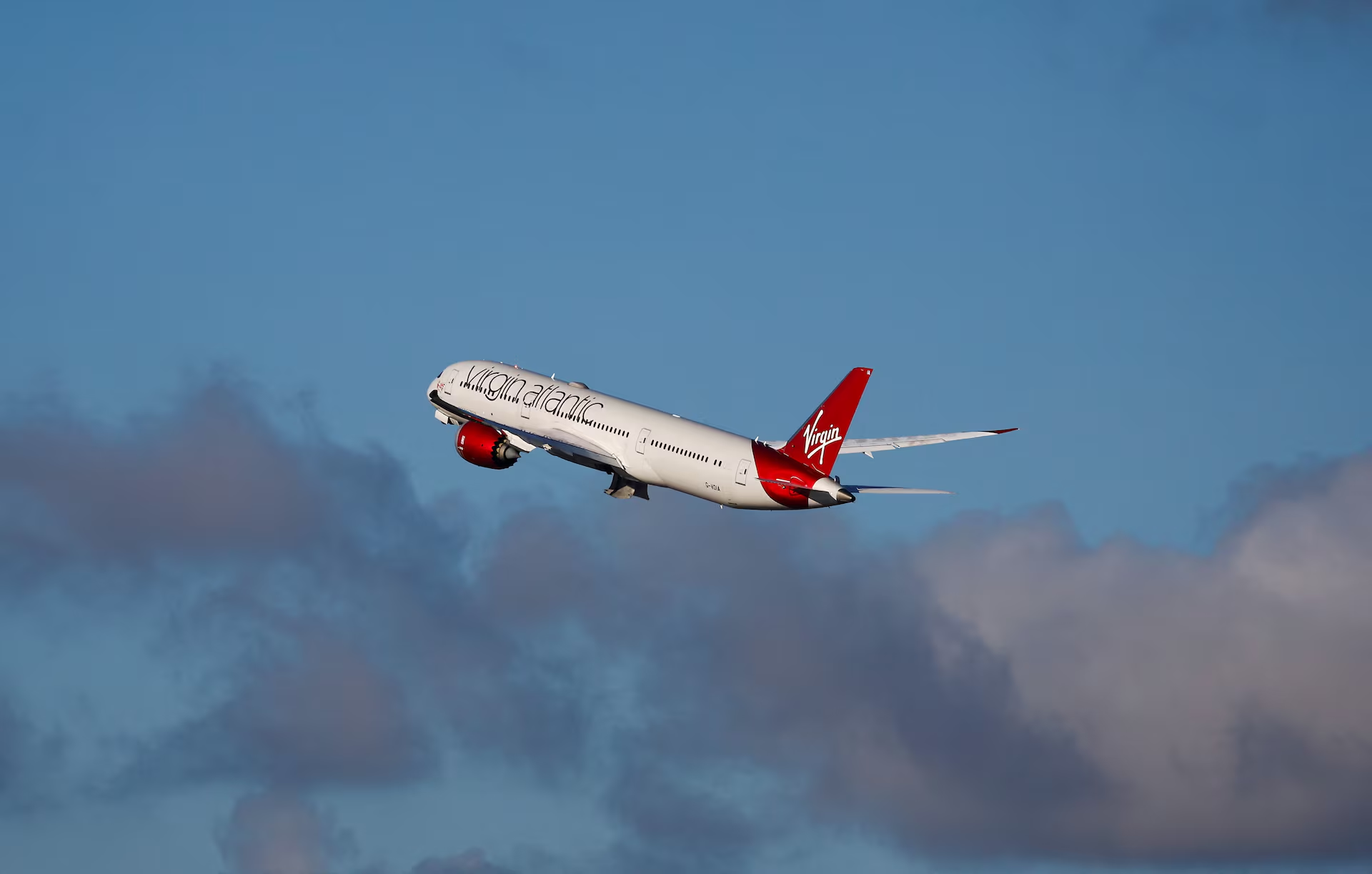
Virgin Atlantic’s entry into the Thai market is arguably the headline development. The British carrier will fly three times a week between London Heathrow and Phuket; a direct route that puts one of Europe’s wealthiest source markets a single flight away from Thailand’s most-visited resort island. British visitors have historically ranked among the higher-spending tourist groups in Thailand, and a direct Heathrow–Phuket service removes the connectivity friction that has long pushed travelers toward competing carriers with one-stop itineraries.
AirBorneo, a Sarawak-owned airline based in Malaysian Borneo, received slots for 14 weekly flights on the Kuching–Suvarnabhumi–Kuching route, making it by far the most frequent of the four new operators. The Kuching–Bangkok corridor taps into Southeast Asian intra-regional travel, which has remained more resilient than long-haul flows. SkyUp Nistru, a Moldova-based charter carrier, will round out the new arrivals with seasonal charter services connecting Chisinau and Phuket via Sharjah in the United Arab Emirates — a routing that opens a pathway for Eastern European travelers looking for a winter sun destination.
The slot conference also produced a broader slate of new and expanded routes connecting Thailand with Helsinki, Taichung, Minsk, London Gatwick, Copenhagen, and Shanghai, among others. A Helsinki–Suvarnabhumi–Melbourne service using fifth-freedom traffic rights was among the more notable additions.
The timing of these announcements matters. Thailand welcomed 32.9 million international visitors in 2025, according to several news sources, a decline of more than 7 percent from the 35.5 million recorded the year before, the country’s first annual drop outside of the pandemic years. Arrivals through the first months of 2026 have continued to track below the prior year, with the Ministry of Finance projecting between 30 and 34 million visitors for the full year. Expanded air access heading into the high season is one of the levers the government has available to close that gap.
For tourism destinations like Phuket, Chiang Mai, and the Eastern Economic Corridor, the injection of new capacity from new source markets, the Middle East, the UK, Southeast Asia, and Eastern Europe, offers a degree of diversification that Thai tourism officials have been calling for. Dependence on any single market, particularly China, has been a structural vulnerability that the drop in Chinese arrivals since 2023 has made harder to ignore.
CAAT said the allocations were managed to maximize airport capacity while meeting international coordination standards, with the goal of promoting inbound travel and supporting both tourism and trade.