Thailand welcomes citizens from 93 countries visa-free and offers visa-on-arrival access to another 31. It’s one of the most generous entry policies in Asia — a system designed to fuel tourism, attract investment, and power the country’s post-pandemic recovery. But a string of recent arrests involving foreign fugitives has raised concern that the open-door policy may have created a security gap too wide to ignore.
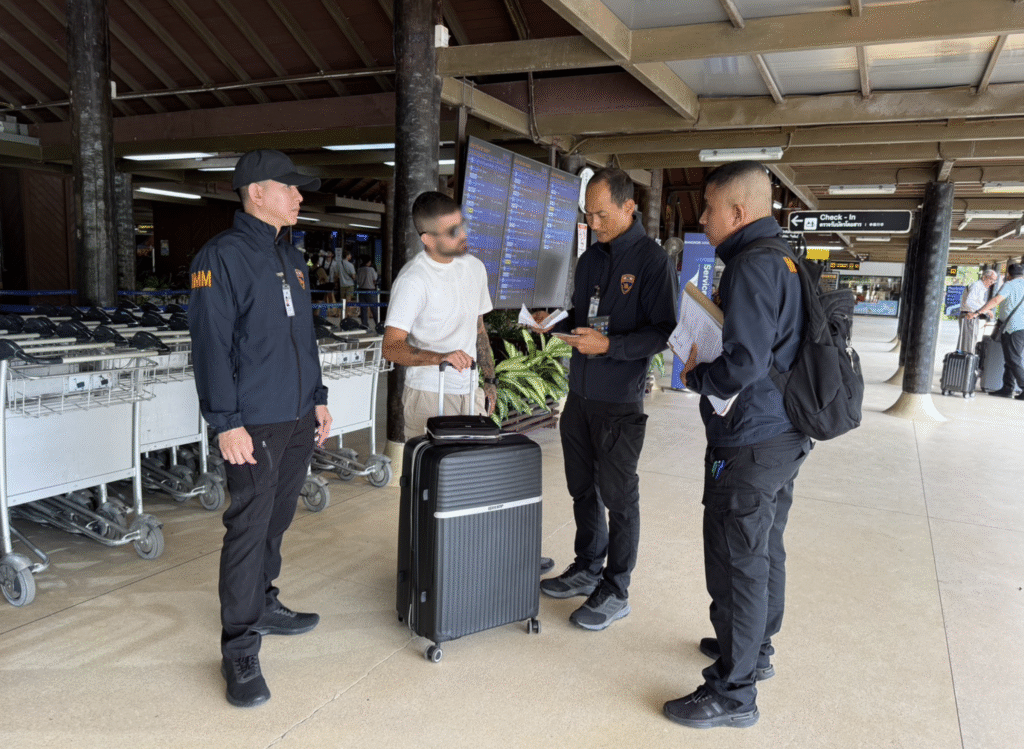
Immigration officers questioned an Israeli national at Koh Samui Airport during an arrest operation linked to an international criminal case.
On November 2, 2025, immigration officers at Koh Samui International Airport arrested 22-year-old Israeli national Osher Farhi, wanted in Israel for armed robbery and burglary. He had entered Thailand as a tourist and was preparing to board a flight out of the country when authorities intercepted him following a coordinated alert from foreign counterparts. His arrest reignited debate over how easily criminals can cross Thailand’s borders under visa-free and visa-on-arrival schemes.
Earlier in the year, on May 3, 2025, a 62-year-old Australian man arriving from Bali was detained at Suvarnabhumi Airport in Bangkok. Immigration officers confirmed that he had been flagged by Thailand’s biometric alert system for an active INTERPOL warrant linked to an armed robbery case in Queensland. He was taken into custody immediately after landing. Officials said the case demonstrated how Thailand’s new biometric technology can work — but also underscored that detection only happens after entry, not before.
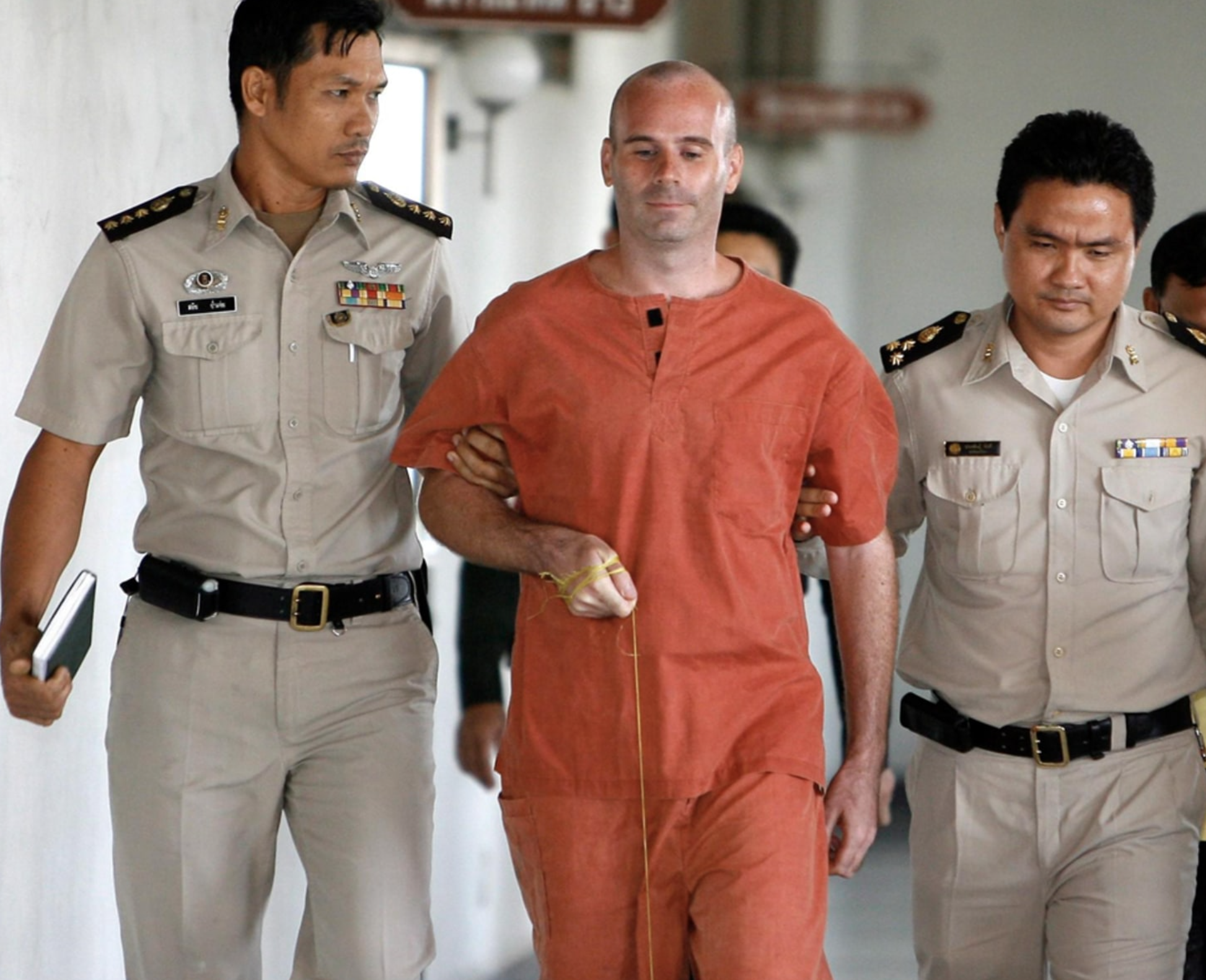
The pattern is not new. In 2007, Canadian schoolteacher Christopher Paul Neil, a convicted child sex offender wanted by INTERPOL, entered Thailand freely on a tourist visa. He was later captured in Nakhon Ratchasima province after a global manhunt exposed his presence in the kingdom. His arrest made international headlines and drew attention to how Thailand’s relaxed entry system had been exploited by predators for years.
These cases — spread across nearly two decades — reveal an uncomfortable truth: Thailand’s visa-friendly model, while vital to economic growth, has become an easy back door for fugitives seeking refuge from justice abroad. Despite improvements in immigration technology, the root weakness persists — a lack of mandatory background screening before arrival.
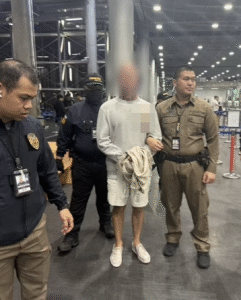
Thai immigration officers escort an Australian suspect through Suvarnabhumi Airport after his arrest on an international warrant in early 2025.
Currently, citizens from 93 countries, including most of Europe, the United States, Japan, and Australia, can enter Thailand without a visa for up to 60 days. Another 31 countries, including China, India, and Russia, qualify for visa-on-arrival, typically valid for 15 to 30 days. Both entry paths require little more than a valid passport, proof of onward travel, and sufficient funds. There is no requirement for police-clearance certificates or criminal-record disclosures.
By comparison, several other nations — including Australia, Canada, and the United Arab Emirates — require even short-stay visa applicants to provide police-clearance certificates before arrival. Thailand, keen to protect its tourism competitiveness, has avoided adding such measures, fearing the extra step might deter visitors.
But immigration data suggests the risk is no longer theoretical. In Phuket, nearly 200 foreigners had their visas revoked last year, and close to 1,000 were deported for criminal activity, mostly drug offences and illegal employment. Russians, French, and British nationals topped the list of offenders, reflecting both Thailand’s international appeal and its vulnerability to abuse. Nationwide, authorities say more foreign nationals are being caught for cybercrime, fraud, and transnational scams — crimes that often rely on the anonymity offered by easy travel.
Immigration officers question a foreign national at Koh Samui Airport during an arrest operation linked to an international criminal case.
Officials inside the Immigration Bureau acknowledge the growing challenge. “We are welcoming the world, but we must also protect Thailand’s safety and reputation,” one senior officer said on condition of anonymity because they were not authorized to speak publicly. “Technology helps, but prevention starts before people get here.”
The Thai government has spent millions of baht installing biometric systems at airports and border crossings, capable of identifying wanted persons through facial-recognition and fingerprint databases. But experts note that such systems can only detect individuals already listed in global databases. Many offenders who have never faced conviction, or whose records remain sealed, can still pass through unchallenged.
Analysts warn that as Thailand’s tourism sector rebounds — projected to attract more than 30 million visitors this year — the pressure to balance openness with security will intensify. “When borders are easy and the numbers are high, the risk always increases,” said a regional security consultant based in Bangkok. “Thailand doesn’t need to shut its doors, but it needs smarter filters.”
Policy experts are urging a middle-ground approach: requiring police-clearance certificates for travelers from nationalities deemed higher risk, expanding pre-arrival data-sharing with partner countries, and tightening oversight of visa extensions. Others suggest a tiered entry system, maintaining visa-free travel for low-risk nations but applying stricter checks for countries with elevated offencse rates.
Tourism accounts for roughly 20 percent of Thailand’s GDP, and policymakers are cautious not to disrupt that flow. Yet, as cases like those in Samui and Bangkok demonstrate, one overlooked fugitive can undo years of reputation-building.
Public debate is also heating up. On social media, many Thai users are asking why individuals wanted abroad can enter the country so easily. Some argue that Thailand should follow the lead of nations that require criminal-record disclosures, even for short visits. Others call for stricter enforcement against overstays, which they say often serve as cover for illicit work or organized crime.
For now, Thailand’s visa-exemption list remains unchanged, and its VOA policy continues to expand. The Tourism Authority maintains that convenience is crucial to sustaining global arrivals. But the steady stream of arrests involving wanted foreigners has made one thing clear: convenience without control carries a cost.
The debate is no longer about whether Thailand should stay open. It’s about how it can stay open — safely.
Because an open door should welcome travelers, not fugitives.