









A fire swept through a densely packed residential settlement in the heart of Bangkok on Sunday morning, damaging more than 60 homes and forcing dozens of families to seek emergency assistance — the latest in a recurring cycle of community fires that exposes an enduring vulnerability in the city’s informal housing.
The blaze broke out in the Rim Khlong Nang Hong community in Bangkok’s Pathum Wan district, with police alerted at 7:50 a.m. at the settlement located on Rama VI Road Soi 15 in Rong Mueang. Authorities confirmed no fatalities, but three people suffered minor injuries, including volunteers who were affected by smoke inhalation while assisting with emergency operations. All three were taken to Police General Hospital for treatment.
Officers from Pathum Wan Police Station, Bangkok Metropolitan Administration officials, disaster prevention personnel, and rescue teams responded to the scene. The densely packed settlement, which contains both commercial buildings and residential properties, made firefighting efforts particularly difficult.
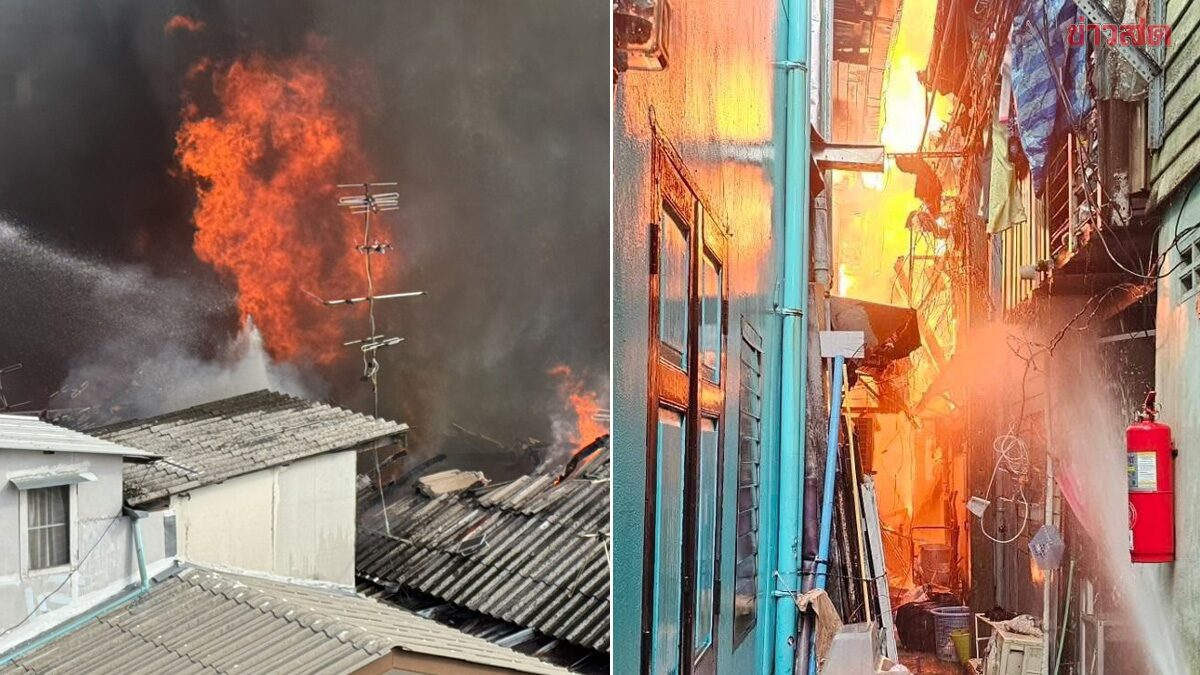
A fire tore through the Rim Khlong Nang Hong community in Bangkok’s Pathum Wan district on June 8, 2026, damaging more than 60 homes and displacing dozens of families in one of the city’s densely packed urban settlements. Photo Courtesy: Khaosod Online
Dozens of fire engines were deployed to contain the blaze and prevent it from spreading to neighboring buildings. Firefighters battled the flames for around three hours before bringing the situation under control, although water continued to be sprayed on hotspots due to the presence of highly combustible materials such as paper and fabric stored within the area.
The scale of destruction underscored just how quickly fire can move through communities like this one. The Rim Khlong Nang Hong community covers approximately eight rai and contains 106 households. Around 58 households registered for assistance shortly after the fire, while district officials later reported that between 70 and 80 affected residents had sought support. The cause of the fire had not been officially confirmed by the time of publishing, according to several news sources.
The fire highlights a challenge that Bangkok authorities have long acknowledged but struggled to resolve. Informal urban communities — tightly built, often on land with contested ownership, and constructed largely from wood and lightweight materials — are disproportionately vulnerable to fire. Narrow access lanes that prevent fire engines from reaching the interior of these settlements mean that by the time firefighters can get water on a blaze, it has already consumed multiple structures.
The Bangkok Metropolitan Administration has been taking steps to address this risk. According to several news sources, the BMA’s Fire and Rescue Department has allocated fire extinguishers to 632 slum communities, 508 urban communities, and 61 suburban communities across the capital, with plans to procure more than 18,600 additional extinguishers in fiscal year 2025 and a further 17,987 in fiscal year 2026. The initiative reflects a growing recognition that placing equipment closer to communities is more effective than relying solely on response time.
But equipment distribution alone hasn’t closed the gap. What remains largely unaddressed is the structural problem: thousands of households in Bangkok occupy land they don’t legally own, in settlements that were never designed with fire safety in mind. When a fire starts, proximity does the rest. Wooden frames, tightly stacked against one another, create corridors for flame rather than barriers against it. The absence of proper electrical infrastructure in older communities also remains a frequent ignition point.
The Rim Khlong Nang Hong fire is far from an isolated incident. Bangkok’s informal communities have seen repeated large-scale fires in recent years, with Khlong Toei, Thonburi, and other inner-city settlements experiencing similar disasters. Each time, the pattern holds: an early-morning blaze, a rapid spread, a community left to rebuild with whatever assistance district officials can provide.
For the families displaced on Sunday, the immediate concern is shelter and replacement of lost belongings. District officials from Pathum Wan were at the scene coordinating relief efforts, though longer-term housing support for affected households had not been formally announced at the time of publishing, according to several news sources.
The broader question the fire raises is one that resurfaces after every such incident: at what point does the frequency and severity of these events compel the city to take more decisive action on the underlying housing conditions that make them almost inevitable?
