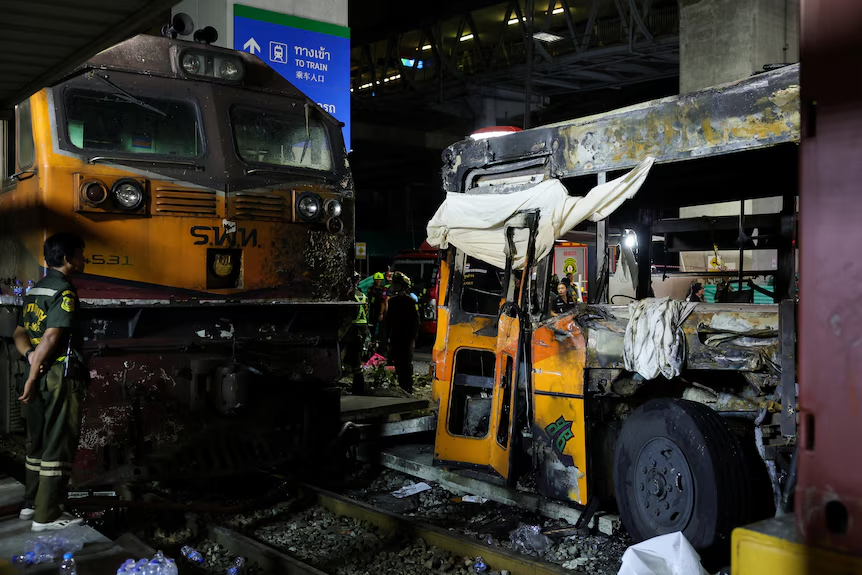









Thai police charged both the train driver and the bus driver with negligence causing death on Sunday, a day after a freight train slammed into a public bus at a level crossing in central Bangkok, killing eight people and injuring at least 32 others. Investigators say the crash was triggered by a chain of events that began with gridlocked traffic — and ended with a bus trapped on the tracks and a fully loaded freight train that couldn’t stop in time.
Freight Train No. 2126, operating on the Laem Chabang Port to Bang Sue Junction route, struck the Bangkok Mass Transit Authority’s Route 206 air-conditioned bus at the Asok-Din Daeng level crossing in Huai Khwang district at around 3:41 p.m. on Saturday, according to several news sources. The bus, which runs between Kasetsart University and Mega Bangna, had been caught in heavy traffic and stopped across the railway tracks while waiting at a red light. With vehicles blocking the crossing, the barrier arms could not descend — and the heavily loaded container train was unable to brake before impact. The bus was engulfed in flames within minutes. The train pushed the wreckage approximately 50 metres along the tracks, striking several nearby cars and motorcycles in the process, spreading the fire to adjacent vehicles.
Firefighters brought the blaze under control by 3:59 p.m. Rescue workers who entered the burned-out bus afterwards found the bodies of all eight victims inside. The injured — including people from the surrounding cars and motorcycles — were transported to several hospitals, including Rajavithi Hospital, Ramathibodi Hospital, and Police General Hospital, according to several news sources.
By Sunday morning, Makkasan police had formally charged Lapit Thongboon, the 56-year-old train operator, with reckless driving causing death, according to several news sources. The 46-year-old bus driver, Sayomporn Suankul, survived the crash but remained hospitalized and could not yet be questioned. Police confirmed he will face the same charge once he is medically fit. Investigators are examining the train’s black box and security camera footage from the area, and said they have not ruled out additional charges.
Bangkok Governor Chadchart Sittipunt, who attended the scene on Saturday alongside Deputy Transport Minister Siripong Angkasakulkiat and BMTA Director Kittikan Chomduang Jaruworapolkul, confirmed that vehicles stopped on the crossing had prevented the barriers from functioning. Under Thai law, drivers are prohibited from stopping on or within five metres of a railway crossing, according to several news sources. Prime Minister Anutin Charnvirakul visited survivors at the hospital on Saturday night and ordered both the State Railway of Thailand and the BMTA to take full responsibility and provide maximum compensation to those affected. He also raised questions about why no railway staff had communicated the track blockage to the train driver before the collision.
The BMTA said it would pay initial compensation of approximately 1.5 million baht to the family of each person killed. Those with general injuries would receive around 80,000 baht, while victims left with permanent disabilities could receive up to 500,000 baht. All medical costs will be covered under compulsory insurance, with the BMTA overseeing the claims process, according to several news sources. The Department of Rail Transport has also launched a separate formal investigation into the crash.
The collision disrupted train services across the Makkasan area for several hours. The State Railway of Thailand coordinated with the BMTA to deploy buses to transport stranded rail passengers between Bangkok Station and Hua Mak Station while the crash site was cleared.
The crash is the second major rail tragedy in Thailand in 2026. In January, a construction crane collapsed onto a passenger train in Nakhon Ratchasima province, killing at least 28 people and injuring dozens more. That disaster prompted a safety review of construction practices near active rail lines. Saturday’s collision at Makkasan has renewed calls for urgent action on level crossing safety across the country — a problem the State Railway of Thailand has acknowledged for years but struggled to address at scale, citing funding constraints and community resistance to closing unauthorized crossings.