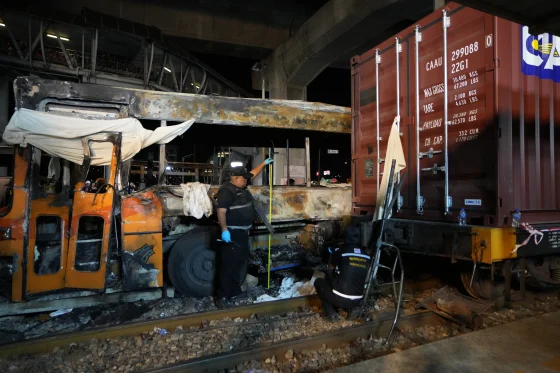









A freight train plowed into a public bus at one of Bangkok’s busiest railway crossings on Saturday, killing eight people and injuring 32 others, as investigators confirmed the train driver had drugs in his system and the government moved to overhaul safety standards across Thailand’s rail network.
The collision happened on May 16 at the Makkasan railway crossing on Asok-Din Daeng Road, near the Airport Rail Link’s Makkasan station, when freight Train No. 2126, traveling from Laem Chabang to Bang Sue, struck air-conditioned bus No. 206 as it sat stalled across the tracks. The impact triggered a fire that spread to nearby vehicles. All eight people who died were passengers on the bus. Forensic officers said identification of several severely burned victims may not be complete until May 19.
By Monday, the story had moved well beyond the crash itself. Investigators revealed that a preliminary drug test found both cannabis and methamphetamine — known locally as yaba — in the system of the train driver, identified as Sayomporn. The State Railway of Thailand’s acting governor, Anan Phonimdaeng, confirmed the results and acknowledged that drug screening had not been a routine part of pre-shift checks for train drivers. Before Saturday’s service, Sayomporn had passed an alcohol test. No alcohol was detected.
Police at Makkasan station summoned Sayomporn and the railway barrier operator, Uthen, to Criminal Court on Ratchadaphisek Road on Monday, where both were detained without bail. Both face charges of negligence causing death and serious injury. Sayomporn declined to answer reporters’ questions. Uthen, while being taken into custody, apologized to the families of the victims and said he had followed procedure — waving a red flag, pressing the barrier button and signaling for the train to stop — though investigators say the two men gave conflicting accounts of what happened at the crossing.
What made the crash particularly complicated, according to the SRT, was a cascading failure of systems. The crossing barriers couldn’t lower because traffic had blocked the tracks. With the barriers up, the standard railway signal the driver would normally see did not activate. That left the driver dependent on visual flag signals from crossing staff — signals the SRT says should have been visible from 300 to 500 meters away. Data from the train’s speed recorder showed emergency braking was applied only about 100 meters before impact, far too late to stop. The train had been traveling at an average of 34 kilometers per hour for roughly 2.8 kilometers from Khlong Tan station.
The SRT is also investigating why Sayomporn was not wearing a uniform during his shift, which would not normally be permitted. The mechanic who was aboard as a technical assistant survived the crash but remains under investigation.
By Monday evening, Transport Minister Phiphat Ratchakitprakarn held a press conference alongside Deputy Transport Minister Siripong Angkasakulkiat to announce a sweeping set of reforms. Starting immediately, all train drivers, bus operators under the Bangkok Mass Transit Authority and drivers at Transport Co would be required to undergo alcohol testing before every shift. Random narcotics checks, previously the norm, would be replaced with 100% drug screening across the board. The ministry said it was raising rail safety standards to a level comparable with aviation.
The ministry also announced that freight trains would be restricted from entering Bangkok’s urban core, removing roughly ten services per day. Oil trains would be barred from the city entirely. Other freight services that still need to operate in Bangkok would be limited to nighttime hours. In the medium term, the government plans to redirect long-distance passenger trains so they terminate at outer stations — western and southern line trains at Taling Chan, eastern line trains at Lat Krabang — where passengers can connect to existing rail links rather than traveling through central Bangkok.
For families of the eight victims, the government announced combined compensation of at least 2.09 million baht per person, drawn from the BMTA, the SRT and the Department of Rights and Liberties Protection. Injured victims will receive medical cost coverage of up to one million baht, with the BMTA covering any amount that exceeds that limit.
Phiphat said agencies had three months to develop wider measures and report progress to him monthly. He made clear the government would not shield anyone found responsible. The SRT has filed a complaint against the train driver and said disciplinary proceedings would follow once criminal charges are formally processed. If supervisors are found to have failed in their oversight duties, the minister said, they would also face immediate action.
The crash has prompted wider scrutiny of Bangkok’s level crossings, which have long been identified as a serious safety risk. According to the Transport Ministry, 16 crossings on the eastern line and three on the western and southern lines are still awaiting an elevated rail solution under the long-planned Missing Link project, which the ministry said it would now accelerate.