








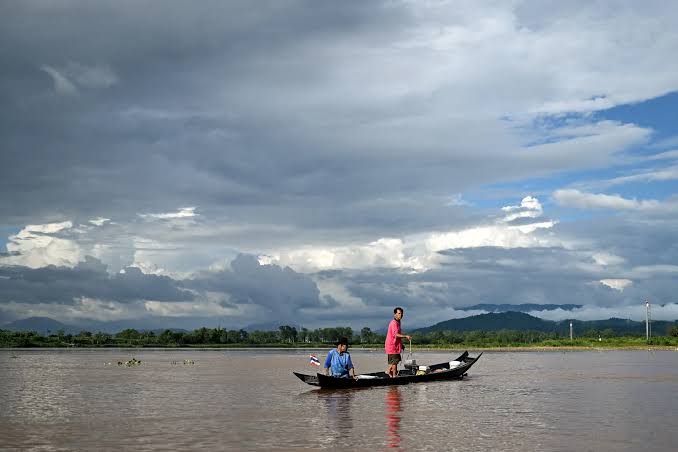
Prime Minister Anutin Charnvirakul has ordered government agencies to provide clean drinking water to communities in Chiang Rai affected by arsenic in the Sai and Kok rivers. On November 18, officials also announced a large testing program to find out whether the contamination, which researchers have linked to mining in neighboring Myanmar, has reached farmland and the food supply.
Deputy Prime Minister and Transport Minister Phiphat Ratchakitprakarn relayed the instructions to the Cabinet on November 17. He chaired the meeting while Anutin was at the ASEAN Summit in Manila. According to several news sources, Anutin told agencies to find alternative water sources, monitor tap water quality closely and have the Provincial Waterworks Authority publish its test results. He has put Phiphat in charge of water quality monitoring and tap water production in Chiang Rai.
More than 20,000 households in northern Thailand have been affected, according to several news sources. On November 5, the waterworks authority cut supplies to 14 villages in Mae Sai district, on the Myanmar border, to 60% of normal after it detected unusually high contaminant levels in raw water drawn from the Sai River. Supplies later recovered to about 80%. Tests reported in recent weeks have found arsenic in the river at more than 20 times the safe limit.
Chiang Rai Deputy Governor Norasak Suksomboon said tap water in the province has been closely tested and is safe to drink. The Public Health Ministry has advised residents to avoid direct contact with river water and sediment. In October, the Department of Disease Control warned people in five Mae Sai subdistricts not to drink or cook with Sai River water.
The new testing program focuses on farms. Deputy Government Spokesperson Capt. Patdarasm Thongsaluaykorn said the Ministry of Agriculture and Cooperatives will check sites from upstream to downstream in both river basins from November 23 to 25, covering 333 locations. The Rice Department, the Department of Agriculture and the Land Development Department will collect 250 soil and water samples from farmers’ fields. The Royal Irrigation Department will test water at 83 points, including major control gates. Fisheries officials will inspect fish ponds, and livestock officials will check for heavy metals in animals raised for food. Results are expected in early December.
Every sampling point will be placed on a color-coded map. Green areas meet standards, yellow areas need close monitoring, and red areas exceed limits and face immediate controls. In red zones, the government plans tighter checks on produce, safety certificates for products that pass, and public release of the findings. It will also help farmers dig small on-farm ponds as backup water sources and encourage a longer-term switch to crops such as rubber, ornamental plants and commercially valuable trees. In October, preliminary tests by the Land Development Department found that about 20% of farmland soil samples in the Kok, Sai and Ruak basins exceeded the arsenic standard.
Thailand is also pressing Myanmar to deal with the problem at its source. On November 17, Deputy Prime Minister and Higher Education Minister Yodchanan Wongsawat offered a Myanmar delegation in Manila Thai experts, personnel and technology to tackle the pollution inside Myanmar, provided Myanmar’s government gives permission.
A working group from Myanmar’s environment ministry is due to meet its Thai counterpart on November 25 and 26. The two countries agreed in August to set up a joint working group on transboundary river pollution, and Foreign Minister Sihasak Phuangketkeow raised the issue with Myanmar President Min Aung Hlaing in Naypyidaw on November 12.
Researchers have linked the contamination to unregulated gold and rare earth mining in Myanmar’s Shan State. Last week, researchers at Naresuan University said chemical analysis and satellite modeling traced much of the arsenic-laden sediment in the Sai River to gold mining across the border.
Opposition lawmakers say the response doesn’t go far enough. Phattarapong Leelaphat, a People’s Party MP who chairs a House subcommittee on cross-border river pollution, said the government hasn’t been serious about stopping the pollution at its source. His subcommittee has proposed moving the working group meeting from Bangkok to Mae Sai so delegates can see the river and hear from residents. He also said recent talks between Anutin and Chinese Premier Li Qiang produced only a draft agreement for a Chinese research institute to supply water testing equipment to Mae Fah Luang University, and didn’t address mining in Myanmar.
The talks in late November and the farm results due in early December should show how far the contamination has spread and whether Thai experts will be allowed across the border. For now, families along the Sai River are relying on emergency water supplies and closer testing, while the source of the pollution remains on the Myanmar side of the border.
17