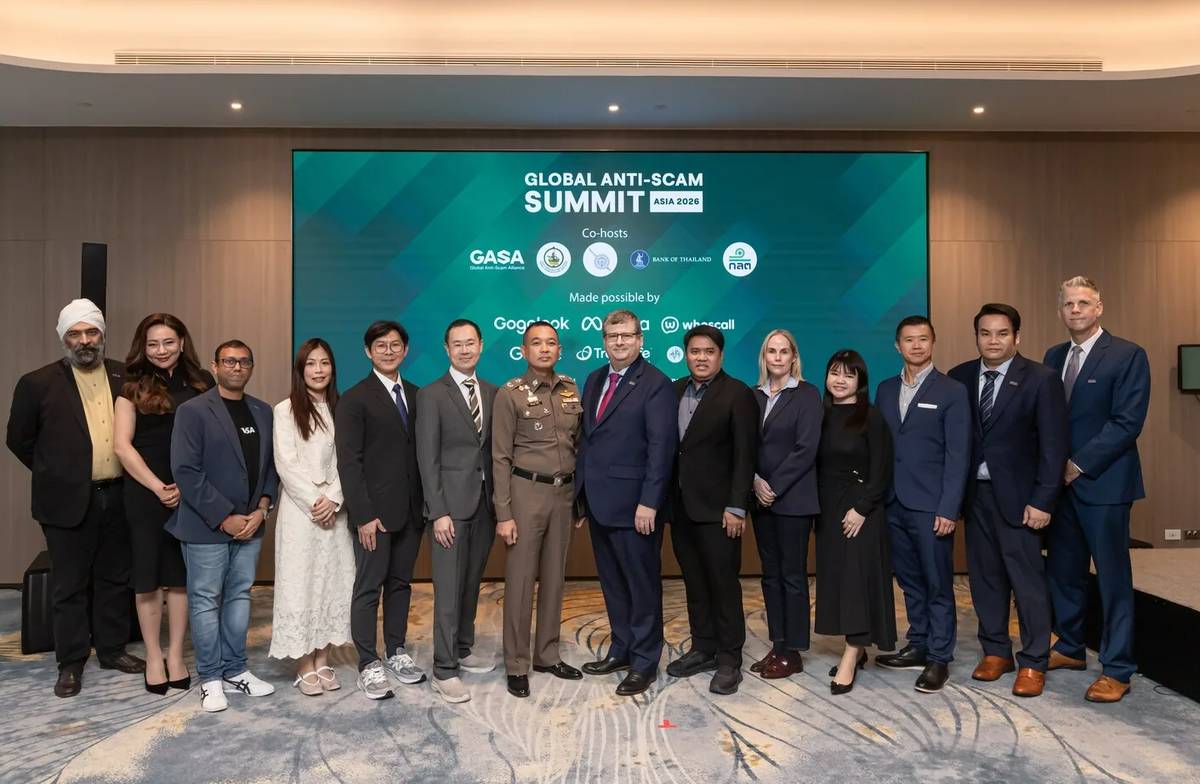








Scammers took an estimated THB65.86 billion, or about US$1.85 billion, from consumers in Thailand over the past year, according to a report released Tuesday, November 10, at the opening of a two-day international anti-scam summit in Bangkok, where organizers also launched a Thai network to coordinate the fight against online fraud.
The State of Scams in Thailand 2026 report, prepared by the Global Anti-Scam Alliance (GASA) with Mastercard and caller ID app Whoscall, was unveiled at the Global Anti-Scam Summit Asia 2026 at the Pullman Bangkok King Power hotel. The meeting runs through Wednesday and has drawn more than 800 participants from government, police, banks, telecom companies, tech firms and civil society, according to several news sources. GASA is holding the event with the Ministry of Digital Economy and Society, the Royal Thai Police and the Bank of Thailand.
The report found that 79% of Thai adults encountered a scam in the past year, up from 72% in 2025. The average victim lost THB11,951, and six in 10 people who lost money said they had been scammed more than once.
Facebook and LINE were the channels scammers used most often to reach people in Thailand, at 54% and 48%. Bank and other electronic transfers accounted for 49% of payments to scammers, well above the Asian average of 36%, while digital wallets came second at 29%.
The harm goes beyond money. About 35% of victims said they still worry about being targeted again, 32% said they trust digital platforms less and 26% reported lingering tension in their personal relationships.
Thailand’s losses are part of a much larger regional problem. GASA’s State of Scams in Asia 2026 report, presented by Gogolook chief executive Jeff Kuo, estimates that consumers in 13 Asian markets lost US$136.5 billion, roughly THB4.6 trillion, over 12 months. The survey of 17,460 adults, carried out in March and April, found that 71% had encountered a scam and that 51% of those who lost money were hit more than once. Kuo said warnings alone aren’t enough and called for faster reporting, quicker help for victims and ways to rebuild trust in digital services.
GASA also formally launched its Thailand Chapter, which links Thai organizations with the alliance’s international network. Kodchasorn Jaijam, managing director of Gogolook Thailand, said the chapter will focus on closer cooperation between government agencies and private companies, sharing research and intelligence on new scam tactics, and public education with consumer and civil society groups. It’s open to new members.
Digital Economy and Society Minister Chaichanok Chidchob opened the summit by stressing cooperation among government, industry, law enforcement and civil society as the basis for a safer digital economy.
Nakarin Amarase, a deputy director at the Bank of Thailand responsible for payment systems policy and financial consumer protection, said scams damage trust before they cause financial losses. He argued that banks, mobile operators, digital platforms and state agencies need to share information in real time, so protecting consumers becomes a shared duty rather than a burden left to individuals.
Beth Ann Lim, Meta’s director of public policy strategy for Asia Pacific, said fraud networks work across borders and exploit several industries at once, so no single government or company can stop them alone. GASA managing director Jorij Abraham said the high share of repeat victims exposes gaps in the support people receive before and after their first loss.
The stakes are high for Thailand, which officials describe as a front line state because so many scam centers operate in Southeast Asia. Foreign Minister Sihasak Phuangketkeow said in March that Thailand had made scam suppression a national agenda and had helped repatriate more than 13,200 trafficking victims from scam centers to over 40 countries since February 2025.
The Bangkok gathering is GASA’s third summit this year, after Lisbon in June and San Francisco in September, and the first Asian edition held in Thailand. The second day focuses on working groups covering research, enforcement, intelligence sharing, prevention and consumer education, and the summit also includes the Scam Fighter Awards.
The new figures show scams are reaching more Thais than a year ago, and many victims are being hit again and again. Speakers from government, the central bank and the tech industry pointed to the same remedy: faster information sharing in real time across banks, platforms, telecom operators and authorities. The new Thailand Chapter is the framework organizers have created to make that happen.