







Thailand plans to ban the export and transit of chemicals used to mine and process rare earths, Deputy Prime Minister Yodchanan Wongsawat said in Bangkok on Saturday. The government is trying to cut off supplies to unregulated mines in Myanmar that officials blame for arsenic contamination in rivers flowing into Chiang Rai and Chiang Mai.
Yodchanan announced the plan after a meeting of the National Disaster Prevention and Mitigation Command at Government House, chaired by Prime Minister Anutin Charnvirakul. He said the restrictions would be pursued through National Security Council mechanisms and would target precursor chemicals used for rare earth production in Myanmar and other countries. He didn’t name the other countries or say when the ban would take effect.
The Ministry of Industry and the Ministry of Commerce will review existing regulations to put the controls in place while limiting harm to legitimate businesses, according to several news sources.
The announcement comes days before a round of cross-border talks. Thai officials are set to meet representatives of China and Myanmar on Tuesday, Nov. 24, with Deputy Prime Minister and Foreign Minister Sihasak Phuangketkeow expected to take part. A Thai-Myanmar joint working group on water quality in border rivers will meet on Nov. 25 and 26. Thailand asked for that meeting to be brought forward after Sihasak raised the pollution with Myanmar’s leaders in Naypyitaw on Nov. 12.
China has also been drawn in. During a visit to Bangkok on Nov. 13, Chinese Premier Li Qiang and Anutin agreed to set up a laboratory in northern Thailand to test for contaminants, with China providing technical support.
The contamination centers on the Kok, Sai and Ruak rivers, which flow into northern Thailand from mining areas in Myanmar’s Shan State. Testing by the Pollution Control Department and research agencies found arsenic in raw water from the Sai River at up to 28 times the safety standard in early August. Those readings came from the river itself, not from treated tap water.
The pollution has already disrupted daily life in Mae Sai, the Chiang Rai district on the Myanmar border. The Provincial Waterworks Authority cut tap water supplies to 14 villages to 60% of normal on Nov. 5 after it detected arsenic above the standard and unusually cloudy water in the Sai. More than 20,000 households in the area have had to pay for bottled water or other supplies, according to local reports.
The government is also moving to give itself stronger legal tools at home. The Ministry of Natural Resources and Environment plans to ask the National Environment Board to designate about 150 kilometers of the Kok River as a pollution control zone. The board, chaired by Deputy Prime Minister Songsak Thongsri, is due to consider the proposal on Dec. 2. If it’s approved, the designation will be published in the Royal Gazette, and the governors of Chiang Rai and Chiang Mai will draw up action plans for their provinces.
Officials plan to install 20 real-time water quality monitoring stations along the Kok, Sai and Ruak rivers and open testing labs in Chiang Mai and Chiang Rai. Samples are currently sent to Bangkok, where results can take up to a month. A field survey running from Nov. 23 to 25 will feed into a risk map that rates locations green, yellow or red, with the map due before Dec. 15.
Health officials say the harm to residents so far appears limited. The Ministry of Public Health said on Sunday that no acute or chronic arsenic poisoning had been diagnosed among at-risk residents under surveillance, and local health authorities have been told to keep monitoring them for at least five years. Yodchanan also said checks on rice from the area hadn’t found the contamination the public had feared.
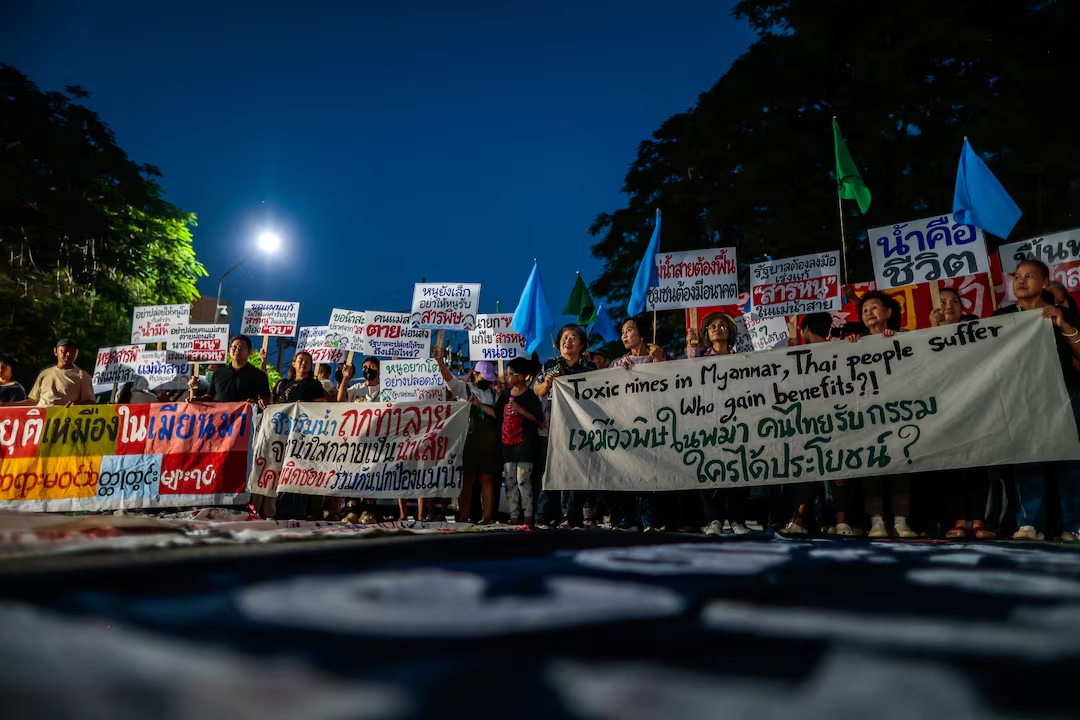
Residents remain wary. Activists staged a protest against rare earth mining near the border in Chiang Rai on Sunday, the same day Yodchanan was due in the province to meet academics, residents and protest groups and hear their proposals.
The chemical ban targets supplies that pass through Thailand, but the mines themselves sit across the border in areas where civil war has weakened the Myanmar government’s control. That leaves much of the outcome riding on this week’s talks and on whether Myanmar and China agree to act at the source. Until then, Thailand’s export ban, the proposed pollution zone and a new monitoring network are aimed at limiting the damage downstream, while families in Mae Sai continue to pay for water they can safely drink.