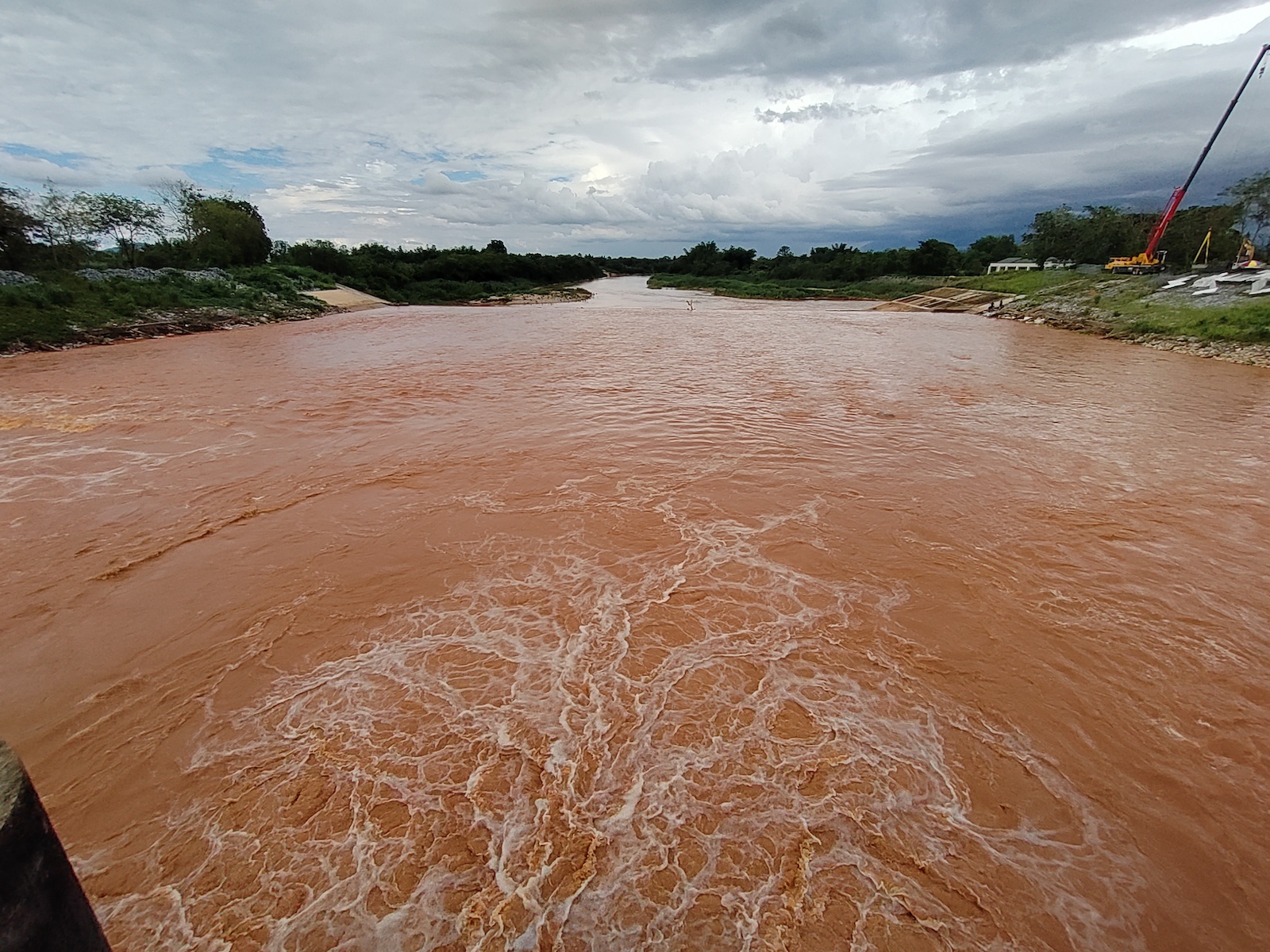








Thailand’s Department of Fisheries on Monday warned people not to eat 10 kinds of fish and shellfish from polluted stretches of the Kok River in Chiang Mai and Chiang Rai, after tests found toxic contaminant levels above safety limits in species that live and feed on the riverbed. The warning followed a meeting in Bangkok of three senior environment and fisheries officials coordinating the government’s response to cross-border river pollution that Thai authorities link to mining upstream in Myanmar.
Officials tested random samples from 300 aquatic species in the river, according to several news sources. Ten exceeded safety limits: freshwater shrimp, golden apple snails, river snails, freshwater mussels, freshwater clams, pangasius catfish, soldier river barb, yellow mystus, northern black sheatfish and sicklefin barb.
The problem is concentrated in the riverbed. Tests found relatively high contamination in sediment along affected stretches, where pollutants settle, putting bottom-dwelling animals at the greatest risk along with the animals that feed on them. Officials said fish that live in midwater or near the surface are considered safe to eat, but they advised people to avoid eating the internal organs of any fish, since that is where contaminants tend to build up.
Officials didn’t release measured concentrations or name every contaminant detected in the 10 species. They explained that aquatic animals can convert some arsenic into an organic form and excrete it in the short term, but they said buildup in the body over time remains a concern.
The meeting brought together Pinsak Suraswadi, director-general of the Department of Fisheries; Surin Worakijthamrong, director-general of the Pollution Control Department; and Phadet Laithong, deputy permanent secretary of the Ministry of Natural Resources and Environment and acting director-general of the Department of Marine and Coastal Resources.
Officials outlined two main next steps. Testing will be expanded to fish raised in cages, particularly along the Mekong River, and to fish raised in ponds, so authorities can identify which farms are safe and which areas are at risk. They also plan to introduce a green, yellow and red flag system to show the public which areas are safe and which carry higher risk. Officials didn’t say when the flag system would take effect.
For people in the north, the warning adds a food safety layer to a problem that has been building for well over a year. The Ministry of Natural Resources and Environment has said that unusual turbidity in the Kok River, along with arsenic contamination above standard levels, has affected the environment, public health and local economies in Chiang Mai and Chiang Rai since March 2025. Concerns have since spread beyond the Kok. In May this year, Thai authorities reported dangerous levels of arsenic in sediment from the Mekong River and three of its tributaries in the two provinces.
The government has consistently pointed to sources across the border. Earlier this month, Natural Resources and Environment Minister Suchart Chomklin described arsenic and heavy metals above standard limits in Chiang Rai’s Sai River as a transboundary pollution problem, noting that Thailand shares the Sai, Kok and Ruak rivers with Myanmar’s Shan State, where mining takes place. Researchers and environmental groups have tied the contamination to gold and rare earth mining operations in that area.
Prime Minister Anutin Charnvirakul last week ordered the ministry to work urgently with Myanmar on the source of arsenic in the Kok and Sai rivers. Under that plan, Thailand will propose joint water quality monitoring on the Myanmar side of the rivers, data sharing, and joint action plans for both the short and long term. On Monday, Anutin said Thailand must rely on international cooperation, scientific evidence and technology to deal with the pollution, because its sources lie beyond Thailand’s jurisdiction.
That leaves officials working on two fronts at once. While diplomacy with Myanmar aims at the source of the pollution, Monday’s findings show that contaminants have already reached some of the animals people catch and eat. For now, the practical advice to residents is to stop eating bottom-dwelling fish and shellfish from affected stretches of the Kok, skip the internal organs of any fish, and watch for the flag system that is meant to show which waters are safe.