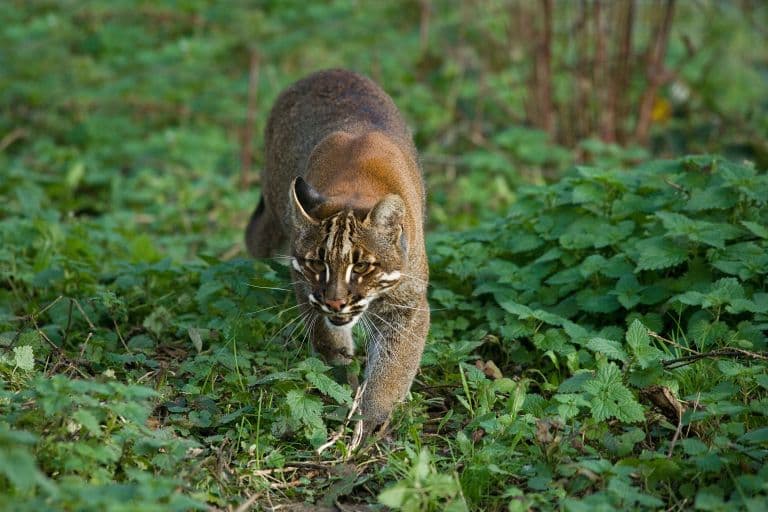









Footage of a rare wild cat long believed to be possibly extinct in parts of Thailand has sparked cautious excitement among conservationists, after images captured by camera traps emerged just as the country entered 2026.
The images, recorded in a protected forest area late last year and publicly discussed in early January, show what wildlife officials and researchers believe is an Asiatic golden cat, a species that has become increasingly difficult to document in Thailand due to habitat loss, poaching, and fragmentation of forest corridors. While the species is not globally extinct, confirmed sightings in Thailand have been rare in recent decades, particularly outside a handful of remote conservation zones.
The footage was captured by motion-sensitive camera traps installed as part of routine wildlife monitoring conducted by park officials and conservation partners. These devices are widely used across Thailand’s national parks to track elusive species without human interference. In this case, the camera recorded clear images of a medium-sized wild cat moving through dense forest at night, displaying physical traits consistent with the golden cat, including body size, tail length, and coat pattern.
Officials stressed that the discovery does not mean the species is suddenly “back” in large numbers. Instead, it suggests that small, fragile populations may still survive in isolated pockets of forest. For conservationists, that distinction matters. Rediscovery is not a sign of recovery; it is a sign of opportunity, and also of risk.
Thailand has made high-profile conservation gains in recent years, particularly in monitoring large mammals such as elephants, tigers, and leopards. Smaller carnivores, however, often receive less attention despite playing crucial roles in forest ecosystems. Wild cats help regulate prey populations and serve as indicators of ecological health. Their disappearance can signal deeper imbalances that affect entire food chains.
Experts caution that rare sightings can also create unintended dangers. Public attention, if not handled carefully, can lead to increased human traffic, illegal tracking, or poaching risks. For that reason, park authorities have withheld precise location details and emphasized that monitoring efforts will continue quietly rather than turning the discovery into a tourism draw.
The appearance of the golden cat also highlights the importance of long-term conservation work that rarely makes headlines. Camera trap programs typically operate for years before producing results like this. The footage does not represent a sudden success, but the accumulation of patient, underfunded, and often overlooked monitoring efforts across Thailand’s forest system.
Environmental groups note that Thailand remains a regional biodiversity hotspot, but one under constant pressure. Infrastructure development, agricultural expansion, and illegal logging continue to fragment habitats, making survival harder for species that require large or connected territories. Climate change adds another layer of stress by altering prey availability and forest conditions.
For policymakers, the sighting reinforces the argument for maintaining and strengthening protected areas rather than weakening enforcement in the name of short-term economic activity. Conservationists argue that once a species disappears entirely, no amount of funding can bring it back. Protecting what remains is far cheaper—and far more realistic—than trying to reverse extinction.
The rediscovery also carries symbolic weight. In a country where environmental news is often dominated by pollution, land disputes, and enforcement gaps, a rare wildlife sighting offers a rare moment of guarded optimism. It suggests that some ecosystems are still resilient enough to shelter species that many assumed were gone.
As Thailand enters another dry season, when forests are especially vulnerable to fire and encroachment, conservationists say the footage should be seen less as a celebration and more as a reminder. The wild cat’s survival depends not on viral attention, but on sustained protection, careful monitoring, and political will.
For now, the animal remains unseen by the public, moving silently through forest corridors that are shrinking year by year. Its brief appearance on camera is both a warning and a promise: what survives today can still be lost tomorrow, but it can also be protected—if action follows discovery.