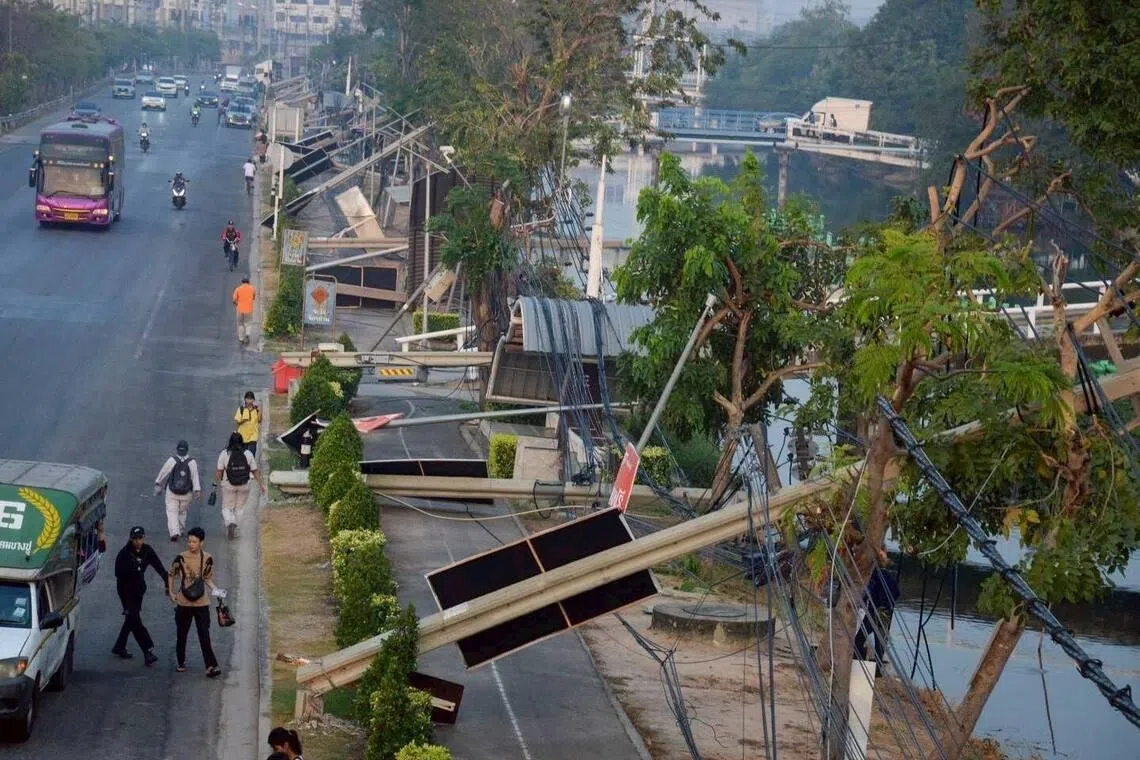









A wave of violent summer thunderstorms swept through upper Thailand on Monday evening, toppling hundreds of power poles, triggering widespread blackouts across multiple provinces, and killing at least one person; with forecasters warning that residents should brace for more of the same through the weekend.
The most severe casualty occurred in Chai Nat province, where a 74-year-old woman on a motorcycle was killed when approximately 30 power poles collapsed onto Phahon Yothin Road during a thunderstorm in Mueang district at around 8:45 p.m. She had been riding home from the neighboring Takhli district in Nakhon Sawan and was found dead beneath the fallen poles roughly two to three kilometers from her home, according to several news sources. Several other people were injured in Nakhon Pathom, where more than 10 poles crashed down onto homes and shops.
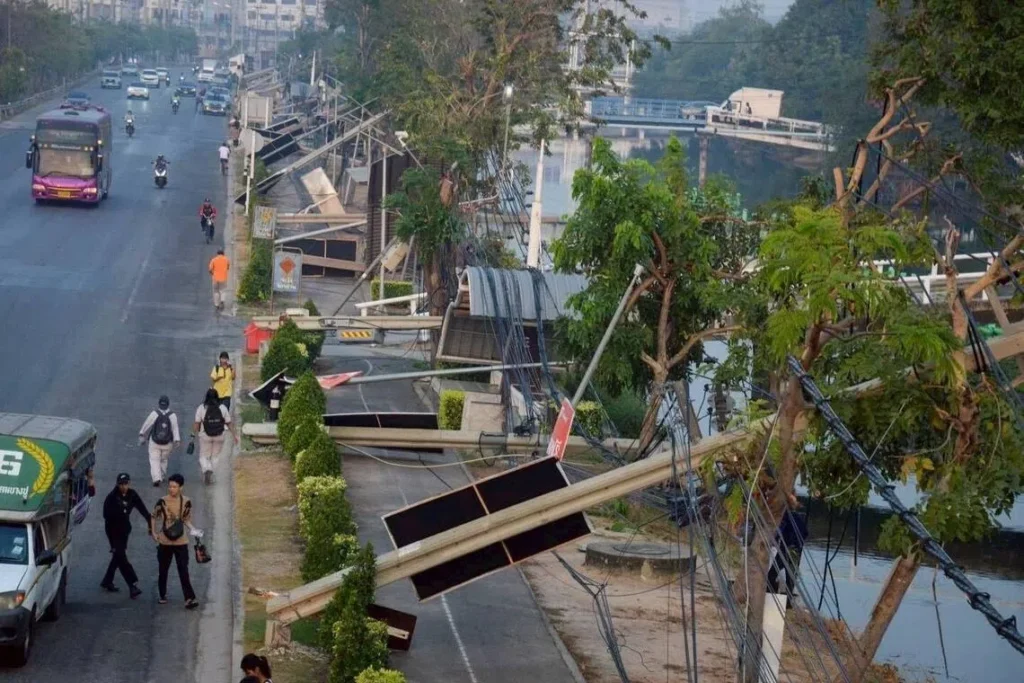
Violent summer storms across upper Thailand toppled hundreds of power poles, killed one woman in Chai Nat, and left several provinces facing blackouts as forecasters warned of more severe weather ahead. Photo Courtesy: The Straits Times
In Suphan Buri, a particularly destructive storm brought down around 100 poles in tambon Ban Pho, Muang district alone, cutting off electricity to entire villages overnight and blocking a key road on the Suphan Buri–Don Chedi route. No injuries were reported there, but the infrastructure damage was extensive, with Provincial Electricity Authority repair crews working through the night to restore service.
The Thai Meteorological Department attributed the violent conditions to a cold air mass from China colliding over the South China Sea with the hot and extremely hot air mass currently sitting over upper Thailand; a classic recipe for severe thunderstorm activity during the country’s pre-monsoon period. By Tuesday morning, the TMD was already warning that more thunderstorms and gusty winds were expected across the upper portion of the country over the next 24 hours, and that southern Thailand faces elevated risk of heavy downpours and flash flooding between Wednesday and Saturday.
The rainy season is expected to begin officially by mid-May, though daytime temperatures are forecast to remain hot to very hot until the rains fully settle in. Residents and motorists across central, northern, and northeastern Thailand have been urged to exercise caution, particularly when driving near roadside infrastructure during and after storms. Authorities have specifically warned people not to approach fallen poles or downed electrical cables, citing the risk of electrocution from live wires.
The week’s storms come on top of a separate, widely reported incident in Chachoengsao province, where a truck carrying lithium batteries caught fire on the Bangna-Trat Road on Sunday evening, scorching part of the elevated Burapha Withi Expressway above and forcing overnight road closures toward Bangkok. Police confirmed this week that the expressway has since been cleared and reopened after engineers certified the structure as safe, though a criminal investigation into the transport of the hazardous materials is ongoing.
Infrastructure stress from storm damage is a persistent seasonal problem across Thailand, where much of the electrical distribution network uses exposed above-ground poles rather than buried cables. Authorities have pushed in recent years to accelerate underground cabling in Bangkok, but progress has been slow and the challenge remains acute across rural provinces each time severe weather arrives.