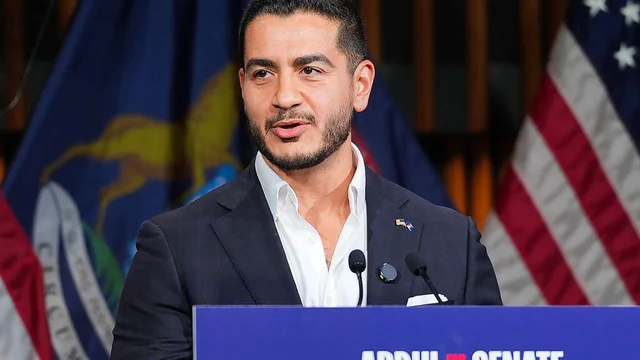








Democrat Abdul El-Sayed has won Michigan’s open US Senate seat, defeating Republican Mike Rogers and becoming the first Muslim American elected to the Senate, according to several news sources. The Associated Press called the race, and El-Sayed declared victory before supporters at a Michigan Democratic Party event in Detroit at about 1:30 a.m. on Wednesday.
El-Sayed, 42, is the son of Egyptian immigrants. He was born in 1984 in Rochester Hills, a northern suburb of Detroit. He will take the seat now held by two-term Democratic Sen. Gary Peters, whose retirement opened the race. With more than 95% of votes counted, he was on track to win more than 52% of the vote, according to several news sources.
The win came on a night of major gains for his party. Democrats won the 2026 midterm elections decisively and will control both the House and the Senate next year, in a result widely seen as a rebuke of President Donald Trump. Because Democrats already held both of Michigan’s Senate seats, El-Sayed’s victory doesn’t meaningfully shift the balance in the chamber. Still, it was one of the most closely watched contests in the country.
El-Sayed came to politics through medicine and public health. He studied at the University of Michigan and earned a doctorate in population health at Oxford as a Rhodes Scholar. He also holds a medical degree from Columbia, though he never practiced medicine. In 2014, he joined the epidemiology faculty at Columbia University’s Mailman School of Public Health. The following year, then Detroit Mayor Mike Duggan appointed him to run the Detroit Health Department, which he took over after the city’s 2013 bankruptcy.
He resigned as Detroit’s health director in 2017, at age 32, to run for governor. He lost the 2018 Democratic primary to Gretchen Whitmer. He later returned to public service as director of Wayne County’s Department of Health, Human and Veteran Services. He had never held elected office before this week.
His road to the nomination was narrow. In the August primary, El-Sayed beat Rep. Haley Stevens by about one percentage point. In the campaign’s final days, Stevens reversed course and endorsed Rogers, after first saying she would back the Democratic ticket.
El-Sayed’s victory came despite massive spending by political groups seeking to defeat him. United Democracy Project, a super PAC affiliated with the American Israel Public Affairs Committee (AIPAC), spent approximately $31.5 million opposing El-Sayed and supporting his Democratic primary rival, Haley Stevens. A key reason was his outspoken criticism of Israel’s military campaign in Gaza and his calls to end US military aid to Israel, positions that sharply contrasted with Stevens’ pro-Israel stance. Across the primary and general election, outside groups spent more than $154 million directly opposing El-Sayed, including major expenditures by Republican-aligned organizations. His victory came despite one of the country’s most expensive Senate campaigns.
El-Sayed ran as a progressive. He tapped into anger over the cost of living and corruption, energizing young and infrequent voters with a focus on single payer health care and on curbing corporate money in politics. He is not a democratic socialist, but some of the biggest names on the political left supported his campaign.
The race was bitter, and El-Sayed’s faith became a central line of attack. Trump repeatedly attacked El-Sayed with labels linking him to terrorism, and Rogers promoted unfounded claims that his opponent had ties to an Islamic terror group. El-Sayed criticized Rogers and other Republicans, including Trump, for using Islamophobic rhetoric against him. In his victory speech, he spoke to parents who had struggled to explain to their children why the president mocked someone for his name or the way he prays. He told them their children should know that the bad guys lost.
Rogers is a former congressman and former chairman of the House Intelligence Committee. This was his second consecutive Senate bid. He lost Michigan’s 2024 Senate race to Democrat Elissa Slotkin by about 19,000 votes.
Michigan had long been seen as competitive ground. No Republican has won a Senate race in the state since 1994, but Peters’ retirement created an unusual opening, and the race became a focus of the national fight for Senate control. Trump narrowly carried Michigan in 2024.
El-Sayed’s election is the latest step in a gradual rise in Muslim representation in Washington. Keith Ellison of Minnesota became the first Muslim in Congress in 2007. Several Muslim Democrats have served in the House since then, but until now no Muslim had been elected to the Senate.
He has signaled he that plans to be a prominent voice as Democrats debate the party’s identity, especially with Michigan expected to play a key role in the 2028 presidential nominating process.