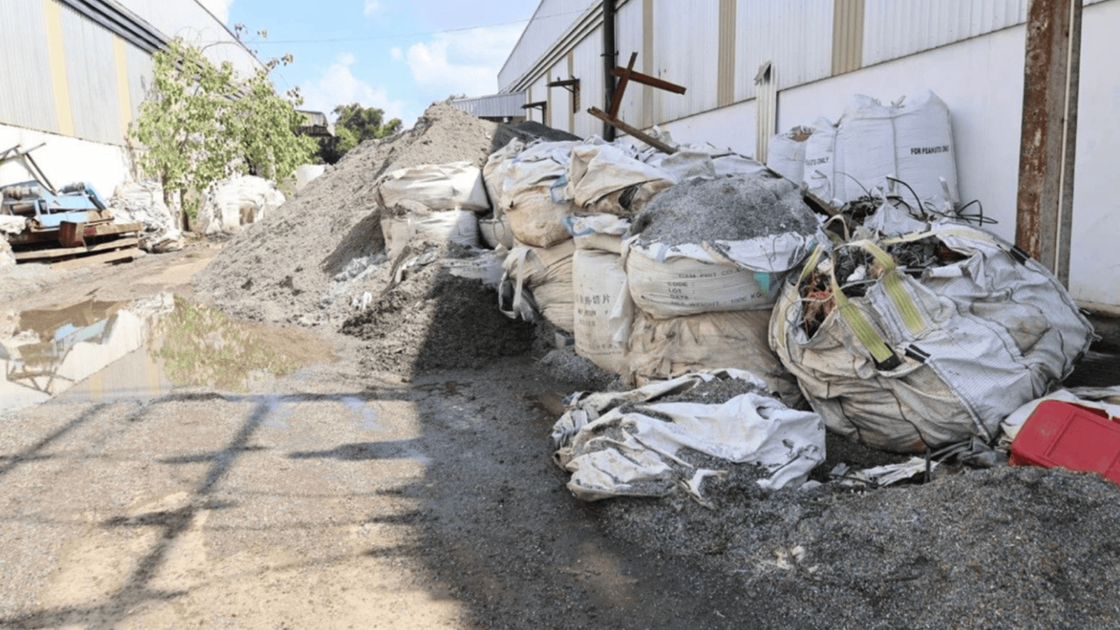








Thai pollution officials and police found more than 6,000 metric tons of hazardous industrial waste and electronic scrap at a warehouse complex in Chachoengsao’s Plaeng Yao district on Wednesday, November 18, according to several news sources. Investigators believe the waste was headed for illegal dumping in neighboring Saraburi province. Preliminary tests found six toxic elements in the material, including arsenic, lead and mercury.
The raid was led by the Ministry of Natural Resources and Environment’s special pollution control task force. It worked with the Pollution Control Department, the governors of Chachoengsao and Saraburi, and officers from Provincial Police Region 1. Natural Resources and Environment Minister Suchart Chomklin had ordered the task force to work with authorities in both provinces to find where the waste came from and who was moving it.
The trail began a day earlier. On Tuesday, November 17, Saraburi provincial police stopped a trailer truck that investigators allege was carrying industrial waste to be dumped in Phu Khae subdistrict, in Saraburi’s Chaloem Phra Kiat district. That stop led officials back to the Plaeng Yao site.
In three warehouses and across the surrounding grounds, officers found large piles of scrap electrical wire, shredded cable insulation, metal scrap and electronic waste. Pollution Control Department staff tested samples at the scene with portable X-ray fluorescence analyzers. The tests detected arsenic, cadmium, lead, mercury, nickel and antimony.
Officials classified the stockpile as Type 3 hazardous substances under Thailand’s Hazardous Substance Act of 1992. The test results are preliminary. Officials warned that if the material were dumped on public land or in waterways, the contaminants could seep into the ground and pose lasting risks to local ecosystems and nearby residents.
Inspectors also found machines used to sort and shred electrical wire, and officials suspect the site was running as an unlicensed factory. The provincial industry office helped impound the machinery and the stockpiled materials.
Investigators described an organized network behind the waste. They said the group moved its disposal operations to Saraburi after the environment ministry and its task force shut down illegal dumping sites in eastern Thailand. Several pits the network had used were closed, and other sites had stopped accepting electronic waste.
According to investigators, the network split its work among three roles: people who arranged disposal sites, scouts who found new locations, and haulers who drove the waste there. Scouts reportedly earned about 4,000 baht per trip. Haulers were reportedly paid between 10,000 and 15,000 baht for each load of 15 metric tons.
Some haulers allegedly let their vehicle tax lapse so they wouldn’t have to meet the Department of Land Transport’s GPS requirements for heavy trucks. Without GPS, authorities couldn’t track those trucks in real time.
The Pollution Control Department has filed complaints against those allegedly involved at Plaeng Yao Police Station. Police plan to trace financial transactions to identify who paid for the operation and who actually owns the warehouses. Authorities say they will pursue both criminal and civil cases, including claims to pay for restoring the environment. Officials haven’t publicly named any suspects, and no charges have been reported.
The raid is part of a wider government push against illegal waste handling. Industry Minister Varawut Silpa-archa has suspended new licenses for waste sorting, disposal and recycling plants, which are classified as factory categories 105 and 106. He has also ordered inspections of all 3,049 registered plants in those categories. Fifty inspection teams began work in five priority provinces: Chachoengsao, Chon Buri, Rayong, Prachin Buri and Samut Prakan.
On November 4, Varawut said officials were considering using money laundering laws against illegal dumping networks. That approach would let authorities go after the profits behind the trade as well as the trucks and warehouses.
The Plaeng Yao investigation now turns to the money. Officials have stopped one shipment and seized the stockpile, but they still don’t know who financed the network or who owns the warehouses. The financial investigation will decide whether prosecutors can charge the people at the top, and the civil cases will help decide who pays to clean up thousands of tons of contaminated waste. Until then, the material stays impounded in Chachoengsao while police work to show how far the network reaches.